1. The Physics of the Stack Effect in Residential Structures
The Stack Effect operates through thermal buoyancy. Warm indoor air rises toward the attic and escapes through roof penetrations, creating negative atmospheric pressure in ground-floor living areas. This pressure gradient vacuums unconditioned, spore-laden air from dirt crawl spaces through plumbing chases, wiring holes, and subfloor joints.
🔬 Subfloor Contamination Vectors:
- Earthen Soil Evaporation: Bare ground releases 10 to 12 gallons of water vapor daily per 1,000 square feet into crawl spaces.
- Structural Wood Rot: Fungal hyphae decompose structural cellulose in floor joists when wood moisture equivalent (WME) exceeds 20%.
- HVAC Duct Infiltration: Negative air leaks in return air plenums pull subfloor fungal spores directly into the HVAC distribution stream.
2. Complete 20-Mil Crawl Space Encapsulation Engineering
Permanent crawl space remediation requires a 4-phase engineered encapsulation protocol:
Phase 1: Hyphal Eradication via Dry Ice Blasting
Technicians blast load-bearing subfloor joists with -109°F CO2 pellets to sublimate fungal roots without chemical toxicity, followed by EPA antimicrobial sealants.
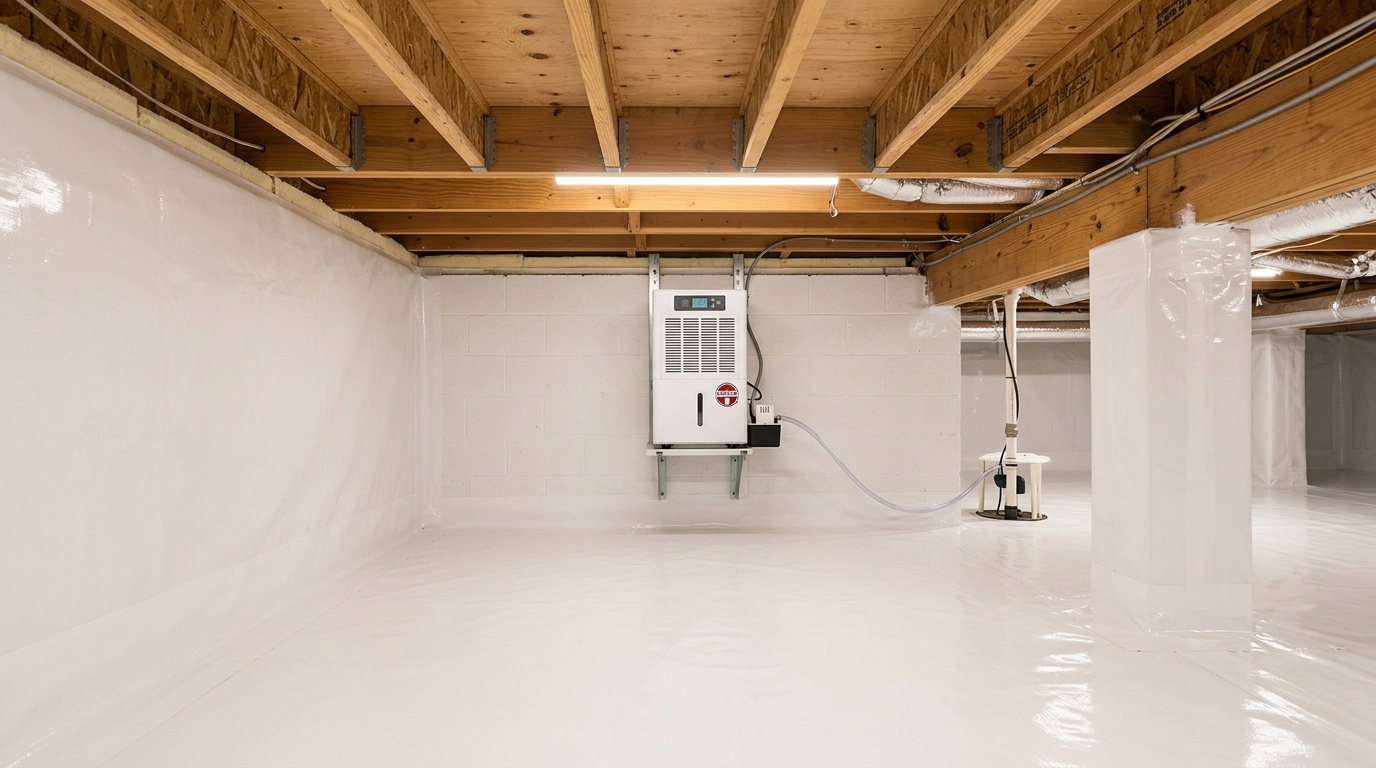
Phase 2: 20-Mil Multi-Layer Reinforced Vapor Barrier
Earthen floors and foundation masonry walls are hermetically lined with 20-mil polyester-scrim reinforced barriers, taped and pinned to create an impervious zero-perm membrane.
Phase 3: Exterior Foundation Vent Sealing
Open exterior foundation vents are permanently sealed with insulated closed-cell polyurethane plugs to block outdoor summer humidity from condensing on cool ductwork.
Phase 4: Dedicated Energy-Efficient Dehumidification
Industrial automatic commercial dehumidifiers maintain subfloor relative humidity below 50% continuously, preventing fungal spore reactivation forever.
Schedule Certified Crawl Space & Attic Remediation
We bill homeowners insurance adjusters directly using standard Xactimate® line-item schedules.
📞 TAP TO CALL 24/7 DISPATCH: (888) 320-1928