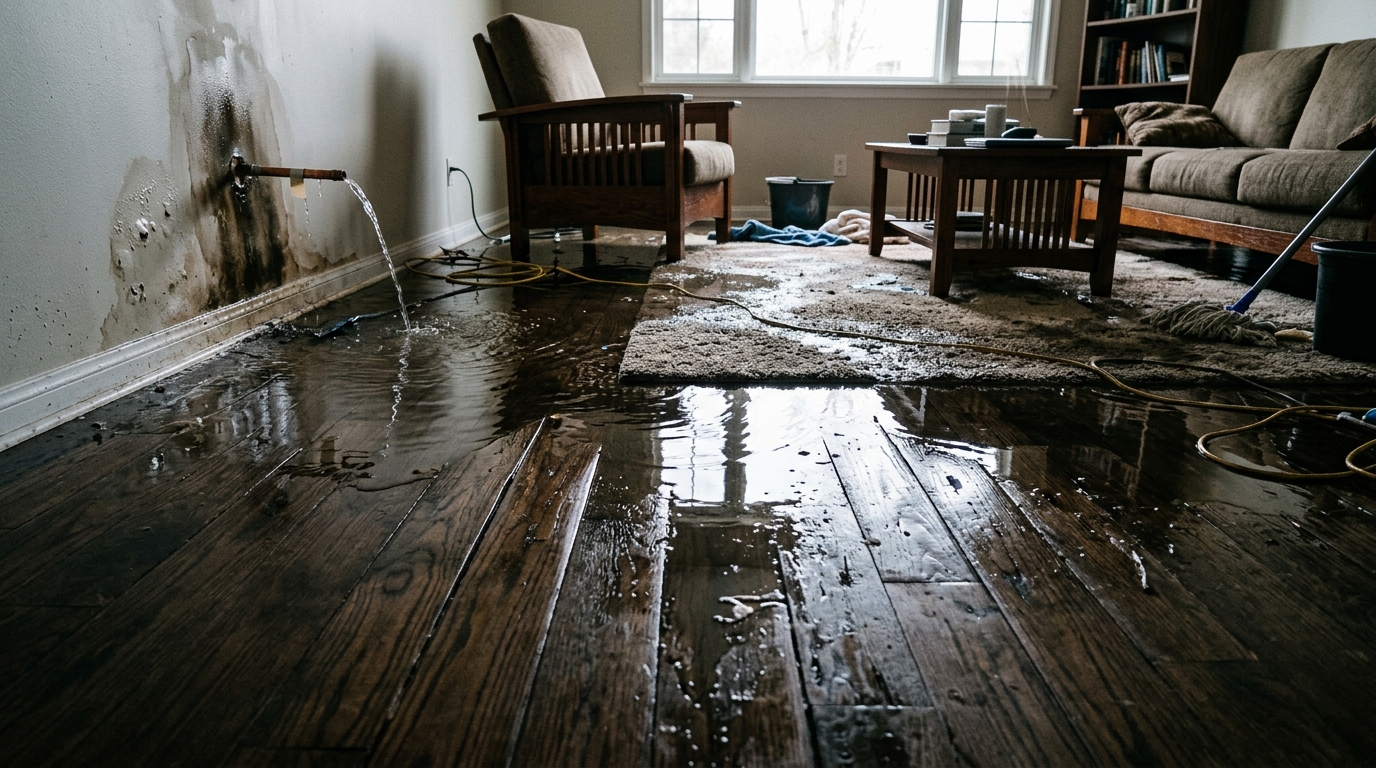
The 60–80 PSI Plumbing Rupture Dynamics & Crimp Failure Mechanics
Flexible braided water connectors consist of an inner core - typically extruded EPDM rubber or Santoprene thermoplastic - sheathed in a protective 304 stainless steel wire mesh braid. While the steel sleeve protects against lateral puncture and burst expansion, the hydraulic integrity relies entirely on the brass end-barb insertion and aluminum or zinc crimp collar. Over 5 to 8 years of continuous municipal service, multiple stress vectors compromise the connection:
- Chloramine Embrittlement: Municipal water sanitizing agents (specifically chloramines and free chlorine) chemically degrade the elastomeric inner liner, causing micro-fissuring and hardening.
- Water Hammer Shock Waves: Rapid shutoff valves in modern appliances (such as solenoid valves in high-efficiency washing machines and dishwashers) send acoustic pressure spikes exceeding 160 PSI backward through the supply line.
- Creep Rupture at the Crimp Barb: Cyclic pressure surges gradually fatigue the metal collar, causing the inner rubber sleeve to slip off the barbed nipple or blow out sideways through gaps in the wire braid.
Hardwood Floor Hygroscopic Expansion: Cupping, Crowning & Cellular Saturation
Solid oak, maple, and engineered hardwood flooring are hygroscopic organic materials that expand and contract in direct proportion to surrounding relative humidity and liquid moisture availability. When pressurized water floods across floorboards, moisture enters through the unfinished tongue-and-groove seams, penetrating the end-grain and bottom face of each plank.
The moisture differential between the top polyurethane finish and the soaking wet underside creates severe mechanical tension are listed below.
- Plank Cupping (Hours 6 to 24): The bottom face of the plank expands rapidly as it absorbs free water, while the sealed top surface remains relatively dry. The edges of the board curl upward, creating concavity across every plank.
- Cellular Crushing & Buckling (Hours 24 to 48): As adjoining planks expand laterally against one another, they exhaust the perimeter expansion gap along baseboards. When lateral force exceeds the structural tolerance of the fasteners, the entire floor assembly buckles upward into large tent-like arches.
- Sleeper & Joist Delamination: In multi-family buildings across Manhattan high-rises and Brooklyn brownstones, water seeps into the subfloor sleeper cavities and concrete deck assemblies, creating dark, stagnant incubators where fungal hyphae establish colonies in under 48 hours.
ANSI/IICRC S500 Standards: Category 1 Degradation Timeline
A critical legal and biological reality of domestic supply line failures is the Category Degradation Window defined under ANSI/IICRC S500 Standard for Professional Water Damage Restoration:
- Hour 0 to 24 (Category 1 - Clean Water): Water originates from a sanitary drinking supply source. If extracted immediately, structural lumber, framing plates, and certain porous materials can be dried in place without hazardous demolition.
- Hour 24 to 48 (Category 2 - Gray Water): As clean water dissolves biological organic dust, dead skin cells, pet dander, and chemical residues inside carpet backing and subfloor crevices, microbial counts escalate exponentially. Water now contains unsafe chemical and microbiological contaminants.
- Hour 48+ (Category 3 - Blackwater Fungal Ecology): High ambient temperatures accelerate fungal spore germination. Once toxigenic mould colonies (including Stachybotrys chartarum and Chaetomium globosum) colonize gypsum paper cores and timber subfloors, the loss transitions into a biohazard requiring full containment under negative pressure (-5 Pascals).
Industrial Injectidry Floor Vacuum Panel Technology
Historically, insurance adjusters ordered the total demolition of water-soaked hardwood flooring following a supply line flood. Today, certified IICRC structural drying technicians deploy negative-pressure vacuum injection drying panels (such as Injectidry® and Rescue Mat systems) to save 80% to 90% of hardwood installations:
- High-Vacuum Air Extraction: Clear gasketed acrylic or composite floor panels are taped airtight over the cupped floorboards. Industrial high-vacuum extractors pull negative pressure across the seams, drawing capillary liquid water directly up out of the subfloor through plank tongue-and-groove joints.
- Vapor Pressure Depression: As liquid water is evacuated, high-capacity commercial Low Grain Refrigerant (LGR) dehumidifiers purge moist air from the containment chamber, forcing deep-seated bound moisture out of the hardwood cellular matrix.
- Psychrometric Equilibrium Verification: Technicians use penetrating resistance pin probes to record daily Wood Moisture Equivalent (WME) readings until structural timber returns to within 2.0% to 4.0% of regional dry standard equilibrium (typically 8.0% to 11.0% WME).
Xactimate® Direct Insurance Billing & Homeowners HO-3 Claim Navigation
Homeowners insurance policies (specifically standard ISO Form HO-3 and HO-5) explicitly cover sudden and accidental discharge of water from domestic plumbing systems. However, insurance adjusters frequently look for pretexts to deny claims - such as alleging 'long-term chronic seepage' or 'homeowner failure to mitigate.'
IICRC-certified restoration contractors eliminate out-of-pocket disputes by generating standardized forensic documentation packages directly inside Xactimate®, the estimating software mandated by major insurance carriers:
WTR EXTW- Heavy-duty truck-mounted water extraction of hard surfaces and subfloor assemblies.WTR DRY- Splicing, containment, and precision flood cut demolition of unsalvageable saturated wall bases.WTR DEHUM- Daily equipment line-item charges for high-output commercial LGR dehumidifiers and desiccant units.WTR INJMAT- Specialized injection mat hardwood floor suction systems calculated per square foot of saved flooring.WTR MICRO- Application of hospital-grade botanical biocides (thymol-based) across framing studs to eliminate fungal spore germination.