Statutory Habitability Thresholds Under California Senate Bill 655
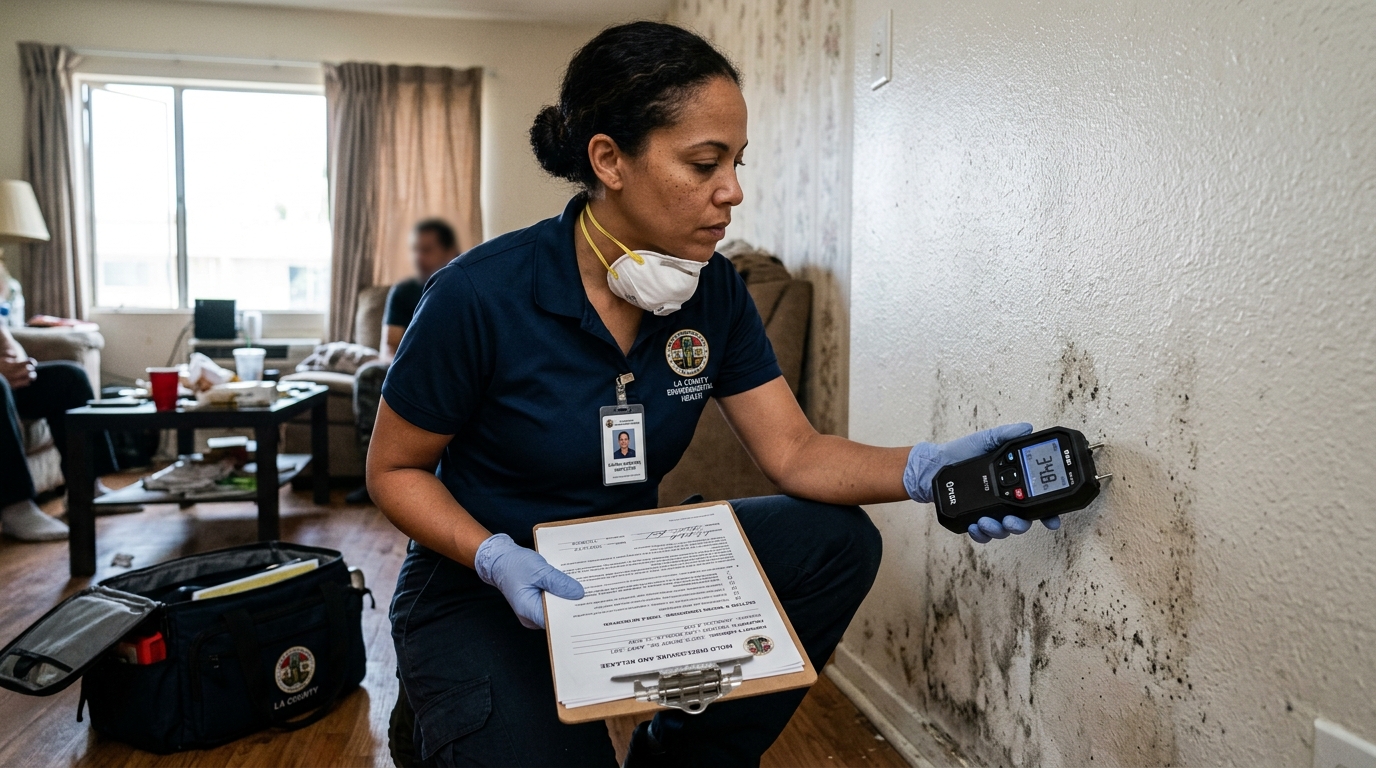
California SB 655 amended Health and Safety Code Section 17920.3 to officially classify visible mold growth as a legally actionable housing deficiency. Under state building standards, residential building inspectors and code enforcement officers can issue formal Notices of Violation against property owners.
California SB 655 amended Health and Safety Code Section 17920.3 to officially classify visible mold growth as a legally actionable housing deficiency.
Under state building standards, residential building inspectors and code enforcement officers can issue formal Notices of Violation against property owners whenever microbial growth endangers the health of occupants.
Unlike cosmetic dirt, structural fungal infestations across organic interior materials (such as Kraft-faced fiberglass insulation, unprimed gypsum drywall, pine wall baseboards, and particleboard subfloors) require professional biological extraction.
If a landlord fails to remediate within 30 days of receiving a public health notice, tenants gain the statutory right under California Civil Code Section 1942 to execute "repair and deduct" remedies or vacate the leasehold without financial penalty.
Mandatory Landlord Real Estate Transfer Disclosures
California law enforces strict pre-lease and pre-sale transparency requirements across all residential property transactions. Under Health and Safety Code Section 26140, residential landlords must distribute the California Department of Public Health (CDPH) Information Pamphlet regarding mold health risks to every prospective tenant.
California law enforces strict pre-lease and pre-sale transparency requirements across all residential property transactions.
Under Health and Safety Code Section 26140, residential landlords must distribute the California Department of Public Health (CDPH) Information Pamphlet regarding mold health risks to every prospective tenant prior to signing a lease agreement.
In purchase transactions, home sellers must disclose all past water intrusions, roof leaks, slab sweating events, and uncertified handyman sheetrock repairs on Section II of the standard California Real Estate Transfer Disclosure Statement (TDS Form).
Sellers who conceal past black mold outbreaks face civil liability for intentional misrepresentation and actual damages under California Civil Code Section 1102.
IICRC S520 Engineering Protocols for California Multi-Family Housing
Remediating multi-family fungal contamination in California requires strict engineering isolation to protect adjacent tenant units from bioaerosol cross-contamination. Certified environmental remediation contractors construct full negative-pressure containment chambers utilizing 6-mil flame-retardant polyethylene sheeting sealed with heavy-duty zippered airlocks. Commercial air scrubbers equipped with.
Remediating multi-family fungal contamination in California requires strict engineering isolation to protect adjacent tenant units from bioaerosol cross-contamination. Certified environmental remediation contractors construct full negative-pressure containment chambers utilizing 6-mil flame-retardant polyethylene sheeting sealed with heavy-duty zippered airlocks.
Commercial air scrubbers equipped with certified 99.97% HEPA filtration operate continuously to maintain a minimum -5 Pascal atmospheric pressure differential. Technicians mechanically extract mold-damaged gypsum wallboard, HEPA vacuum exposed structural Douglas fir studs, and apply EPA-registered botanical biocides formulated with natural thymol.
Post-Remediation Verification (PRV) Clearance Standards
A California mold remediation project is legally complete only when an independent Indoor Environmental Professional (IEP) conducts a comprehensive Post-Remediation Verification (PRV) assessment. The IEP collects quantitative spore trap air cassettes (such as Air-O-Cell) inside the containment zone at an intake flow.
A California mold remediation project is legally complete only when an independent Indoor Environmental Professional (IEP) conducts a comprehensive Post-Remediation Verification (PRV) assessment.
The IEP collects quantitative spore trap air cassettes (such as Air-O-Cell) inside the containment zone at an intake flow rate of 15.0 liters per minute (LPM) for 10 minutes.
An AIHA-accredited environmental laboratory analyzes the samples to verify that total indoor fungal spore concentrations are lower than outdoor baseline reference counts, confirming IICRC Condition 1 normal fungal ecology.
The resulting PRV certificate provides landlords and property managers with an ironclad legal defense against tenant liability claims.