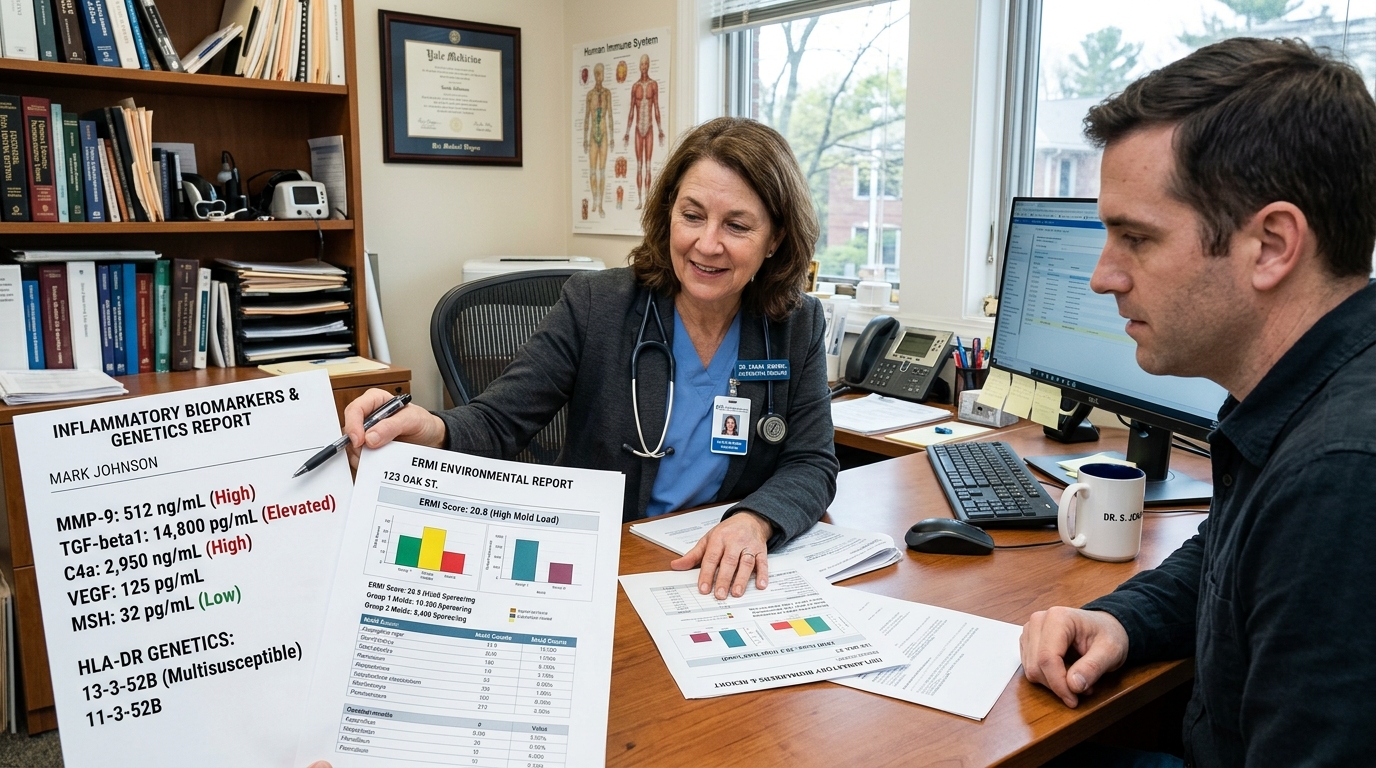
Genetic Pathophysiology: HLA-DR Gene Malfunction & Cytokine Storms
The major histocompatibility complex (MHC Class II) on chromosome 6 encodes HLA-DR and HLA-DQ cell-surface receptors responsible for presenting foreign antigens to helper T-cells. In individuals with genetic "dreaded" or mold-susceptible haplotypes (such as HLA-DRB1 4-3-53, 11/12-3-52B, or 7-2/3-53), the antigen-binding groove.
The major histocompatibility complex (MHC Class II) on chromosome 6 encodes HLA-DR and HLA-DQ cell-surface receptors responsible for presenting foreign antigens to helper T-cells.
In individuals with genetic "dreaded" or mold-susceptible haplotypes (such as HLA-DRB1 4-3-53, 11/12-3-52B, or 7-2/3-53), the antigen-binding groove cannot correctly bind small, lipophilic biotoxin molecules.
Because the adaptive immune system never mounts an antibody response, the innate immune system attempts to compensate by churning out massive quantities of non-specific inflammatory mediators, resulting in chronic microvascular damage and cellular hypoxia.
Diagnostic Biomarker Panel for CIRS
Accurate clinical diagnosis of CIRS relies on objective laboratory biomarker panels rather than subjective symptom checklists: (1) Highly sensitive indicator of innate immune hyperactivation. (2) Master driver of pulmonary remodeling, autoimmunity, under certified ANSI/IICRC S520 environmental engineering standards and forensic structural moisture.
Accurate clinical diagnosis of CIRS relies on objective laboratory biomarker panels rather than subjective symptom checklists: (1) Highly sensitive indicator of innate immune hyperactivation. (2) Master driver of pulmonary remodeling, autoimmunity,
and T-regulatory cell dysfunction. (3) Mediates blood-brain barrier permeability and tissue degradation. (4) Neuro-hormone depleted in CIRS, causing sleep disruption, leaky gut, and chronic pain. (5) Dysregulation causes chronic dehydration and frequent urination.
The 12-Step Shoemaker Medical Protocol
The clinical roadmap for resolving CIRS follows a strict sequential hierarchy: (1) Complete removal from water-damaged indoor environments (HERTSMI-2 score <10). (2) Oral bile acid sequestrants (such as Cholestyramine or Welchol) to bind circulating mycotoxins in the gastrointestinal tract and prevent enterohepatic reabsorption.
The clinical roadmap for resolving CIRS follows a strict sequential hierarchy: (1) Complete removal from water-damaged indoor environments (HERTSMI-2 score <10). (2) Oral bile acid sequestrants (such as Cholestyramine or Welchol) to bind circulating mycotoxins in the gastrointestinal tract and prevent enterohepatic reabsorption. (3) Eradication of MARCoNS (Multiple Antibiotic Resistant Coagulase Negative Staphylococci) from deep nasopharyngeal crypts. (4) Correction of elevated MMP-9,
C4a, and TGF-β1 using specialized pharmaceuticals and natural bio-flavonoids. (5) Final restoration of VIP (Vasoactive Intestinal Peptide) via intranasal administration to repair pulmonary hypertension and normalize central nervous system inflammation.
Environmental Remediation: Achieving ERMI & HERTSMI-2 Safety Thresholds
A CIRS patient cannot heal while remaining inside a contaminated building. Remediating for CIRS requires far stricter standards than basic real estate clearances: (1) executing DNA-based Environmental Relative Moldiness Index (ERMI) and HERTSMI-2 dust PCR testing, (2) engineering negative-pressure containment (-5 Pa).
A CIRS patient cannot heal while remaining inside a contaminated building.
Remediating for CIRS requires far stricter standards than basic real estate clearances: (1) executing DNA-based Environmental Relative Moldiness Index (ERMI) and HERTSMI-2 dust PCR testing, (2) engineering negative-pressure containment (-5 Pa) with 100% HEPA air filtration, (3) physical removal of all contaminated building substrates, and (4) whole-house small-particle micro-cleaning using hospital-grade HEPA vacuuming and electrostatic wiping to reduce indoor fungal DNA counts below the strict HERTSMI-2 threshold of 10 points.