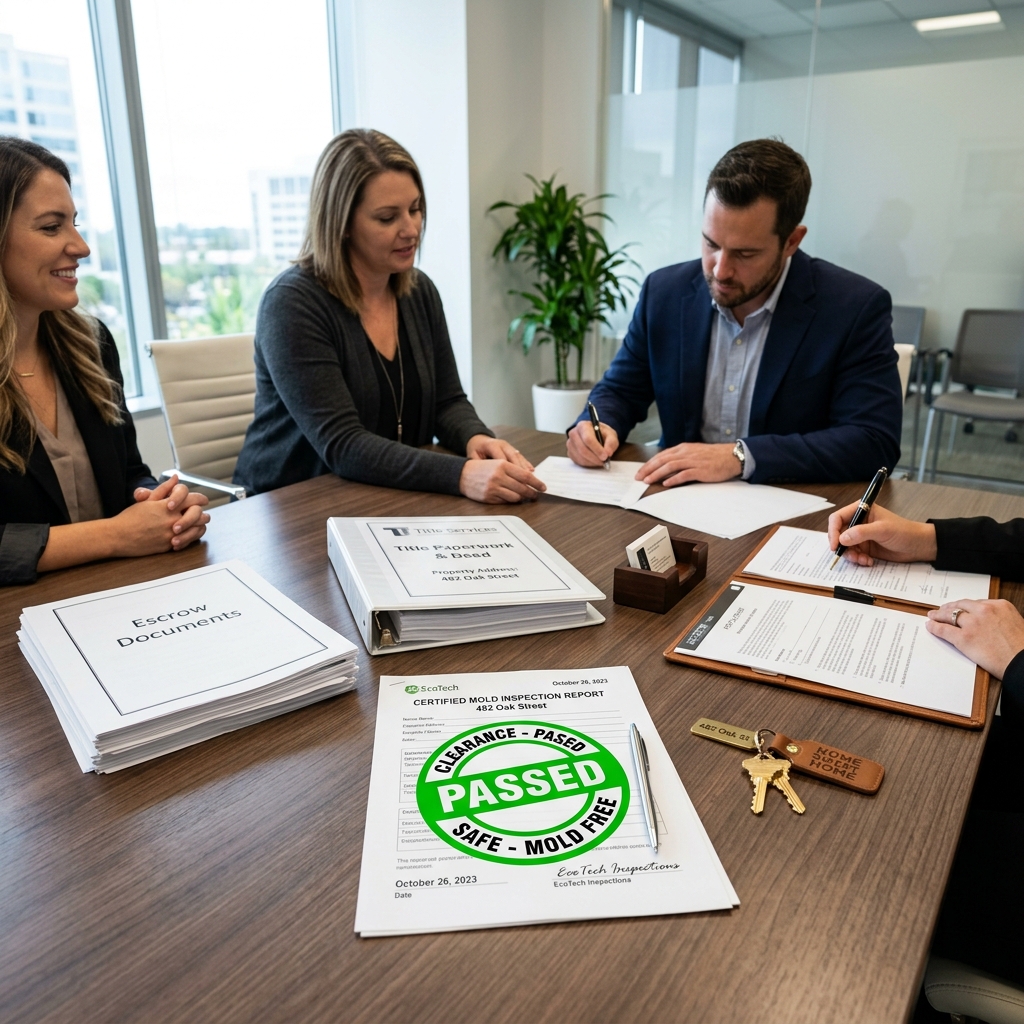
1. The Financial Architecture of a 150% Escrow Holdback Agreement
Title companies and closing settlement attorneys require 1.5 times (150.0%) of the licensed remediation contractor's formal repair estimate deposited into an escrow account whenever environmental remediation cannot be completed before scheduled closing dates. The additional 50.0% financial buffer protects mortgage lenders and.
Title companies and closing settlement attorneys require 1.5 times (150.0%) of the licensed remediation contractor's formal repair estimate deposited into an escrow account whenever environmental remediation cannot be completed before scheduled closing dates.
The additional 50.0% financial buffer protects mortgage lenders and property buyers against unforeseen hidden contamination (including rotten subfloor joists behind bathroom tubs, wet insulation inside exterior wall cavities, and rotted roof decking) discovered during physical demolition.
The settlement attorney retains these funds in a dedicated non-interest-bearing escrow account established under an official Escrow Holdback Agreement signed by the buyer, seller, lender, and title officer.
This legal agreement outlines exact disbursement conditions, completion milestones, and contractor licensing requirements, ensuring the transaction closes without buyer rate-lock expirations or seller contract extensions.
2. Lender Underwriting Criteria for Post-Closing Environmental Escrows
Mortgage lenders authorize repair escrow holdbacks only when mold contamination does not compromise the immediate structural safety or habitability of the property. Underwriting guidelines for conventional loans (Fannie Mae and Freddie Mac), FHA 203(b) standard loans, and VA mortgages permit repair escrows.
Mortgage lenders authorize repair escrow holdbacks only when mold contamination does not compromise the immediate structural safety or habitability of the property.
Underwriting guidelines for conventional loans (Fannie Mae and Freddie Mac), FHA 203(b) standard loans, and VA mortgages permit repair escrows for localized environmental issues (such as attic roof deck sheathing, basement perimeter wall framing, and crawl space vapor barrier upgrades).
Conventional lenders restrict total repair escrow amounts to 10.0% of the total appraised property valuation or a maximum cap of $10,000 to $20,000.
Mortgage underwriters enforce strict completion deadlines requiring all physical remediation and clearance testing completed within 14 to 30 calendar days of loan closing. Lenders require the remediation contractor to furnish active General Liability insurance ($1,000,000 minimum), Workers' Compensation coverage, and state mold remediation licenses.
3. Formulating the Scope via Industry-Standard Xactimate Line Items
Certified remediation contractors generate itemized repair estimates using Xactimate pricing databases recognized by title attorneys and insurance adjusters nationwide. The itemized scope of work outlines exact quantities for critical containment elements, including 6-mil flame-retardant poly sheeting (WTR BARR6), commercial HEPA 500 air.
Certified remediation contractors generate itemized repair estimates using Xactimate pricing databases recognized by title attorneys and insurance adjusters nationwide.
The itemized scope of work outlines exact quantities for critical containment elements, including 6-mil flame-retardant poly sheeting (WTR BARR6), commercial HEPA 500 air scrubbers (WTR DHAM), antimicrobial botanical applications (WTR GRMB), and cryogenic dry ice blasting hours (WTR DRYICE).
Utilizing standardized unit pricing prevents disputes between buyers and sellers regarding allocated repair sums. Real estate attorneys attach this line-item Xactimate estimate directly to the closing settlement disclosure, ensuring exact capital allocation for all required containment, demolition, and clearance procedures.
4. Physical Remediation Execution Under Post-Closing Deadlines
Remediation crews begin structural decontamination immediately following loan closing to meet the lender's 14-to-30-day compliance deadline. Technicians erect critical dust barriers under -5 Pascals negative pressure, stripping water-damaged materials (including saturated gypsum board, contaminated baseboards, and ruined acoustic tiles) in heavy-duty containment bags.
Technicians deploy solid CO2 dry ice pellets at -109.3°F to abrade structural framing without introducing secondary moisture into the structure. Continuous HEPA air filtration scrubs indoor bioaerosols at 99.97% efficiency down to 0.3 microns, preparing the space for final environmental clearance testing.
5. Third-Party Environmental Verification and Clearance Protocols
Mortgage underwriters release held repair escrow funds only after receiving independent scientific proof of successful remediation. Following physical cleaning, a third-party Council-certified Indoor Environmental Consultant (CIEC) conducts a thorough visual inspection and collects bioaerosol air samples inside former containment chambers.
AIHA-accredited laboratory analysis must confirm indoor fungal spore concentrations remain statistically lower than outdoor baseline levels, with zero toxic marker species detected in living areas. This independent verification guarantees that the newly purchased property meets strict Condition 1 normal fungal ecology standards.
6. Fund Release and Final Escrow Overage Reconciliation
Title officers disburse held escrow funds upon receipt of the final invoice and signed Post-Remediation Verification (PRV) lab clearance report. The settlement company pays the licensed remediation contractor directly according to the agreed repair contract, returning all remaining escrow overage funds to.
Title officers disburse held escrow funds upon receipt of the final invoice and signed Post-Remediation Verification (PRV) lab clearance report.
The settlement company pays the licensed remediation contractor directly according to the agreed repair contract, returning all remaining escrow overage funds to the seller within 3 business days.
If unforeseen moisture damage requires additional remediation beyond the base estimate, the contractor documents the structural variation with digital photographs and submits a supplemental scope to the title officer.
The 50.0% contingency cushion covers these supplemental line items, preventing construction stoppages or contentious post-closing negotiations between the new homeowner and previous seller.
7. Title Settlement Disbursement Workflows and Lien Waivers
Closing settlement attorneys protect property buyers from mechanics liens by requiring licensed remediation contractors to submit signed Final Unconditional Lien Waivers alongside their final billing statements. Title officers disburse held escrow funds directly to the environmental firm via certified wire transfer within.
Closing settlement attorneys protect property buyers from mechanics liens by requiring licensed remediation contractors to submit signed Final Unconditional Lien Waivers alongside their final billing statements.
Title officers disburse held escrow funds directly to the environmental firm via certified wire transfer within 24 hours of receiving the passing Post-Remediation Verification lab certificate.
The title company issues a formal Final Settlement Accounting Statement to both buyer and seller, documenting all disbursed contractor repair funds and returning any remaining escrow contingency overage to the seller via electronic deposit.
8. Frequently Asked Questions About Mold Escrow Holdbacks
Who determines the total dollar amount for the escrow holdback? Mortgage underwriters and title companies mandate 150% of the licensed contractor's formal Xactimate repair estimate to cover unforeseen structural discoveries.
What happens if actual remediation costs exceed the original estimate? The 50% escrow cushion covers documented supplemental expenses, provided the contractor submits itemized photographic proof and lender-approved change orders.
9. Coordinating Contractor Scheduling with Buyer Move-In Dates
Real estate agents streamline post-closing remediation by aligning contractor access schedules with buyer occupancy timelines immediately following loan funding. Environmental contractors deploy negative-air containment chambers before buyer furniture arrives, isolating affected areas completely from clean household living spaces. under certified ANSI/IICRC S520.
Completing structural cleaning and PRV clearance testing within the first 7 to 10 days post-closing allows buyers to proceed with general moving and decorating without bioaerosol health concerns.
Authored by Antonio
Lead Environmental Health & IICRC Certified Remediation Specialist • Technical Standards Division • Emergency Mold Inspection Network
Related Real Estate & Inspection Guides
Real Estate Guide Failed Home Inspection Due to Attic Mold: How to Save Your Closing in 48 Hours Read Article → Real Estate Guide Mortgage Lender Denied Loan Due to Crawl Space Mold? FHA & VA Clearance Read Article → Real Estate.