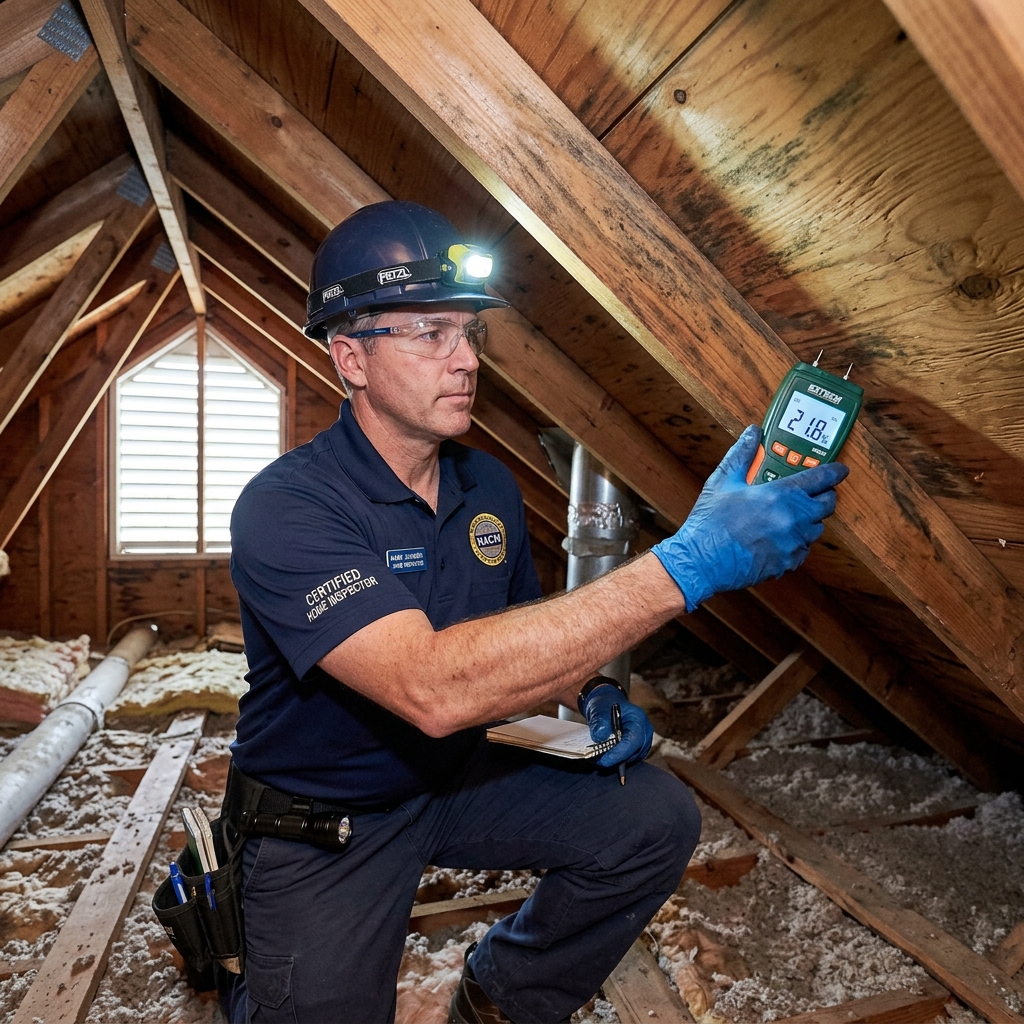
1. Why Attic Mold Triggers Immediate Escrow Stoppages
Mortgage lenders halt loan funding immediately when general home inspectors document visible fungal growth on attic roof sheathing (such as oriented strand board, Douglas fir rafters, and plywood decking). Underwriting guidelines established by Fannie Mae, Freddie Mac, the Federal Housing Administration (FHA).
Mortgage lenders halt loan funding immediately when general home inspectors document visible fungal growth on attic roof sheathing (such as oriented strand board, Douglas fir rafters, and plywood decking).
Underwriting guidelines established by Fannie Mae, Freddie Mac, the Federal Housing Administration (FHA), and the Department of Veterans Affairs (VA) prohibit closing loans on residential properties with unmitigated environmental or structural hazards.
Underwriters classify uncertified attic mold as active wood rot that threatens structural integrity and occupant respiratory health.
Fungal bioaerosols migrate downward into living spaces through ceiling penetrations (including recessed canister lights, ceiling fan junction boxes, plumbing vent stacks, and attic access hatches) due to natural thermal air currents known as the Stack Effect.
When warm air rises and escapes through roof ridges, negative pressure draws contaminated attic air into second-floor bedrooms whenever bathroom exhaust fans or HVAC air handlers cycle.
Home buyers frequently demand contract cancellations or $15,000 to $30,000 closing credits unless the seller executes certified physical remediation and supplies third-party laboratory clearance documentation within the 10-day inspection contingency period.
2. The 4 Root Causes of Real Estate Attic Mold Contamination
Attic fungal amplification occurs when excessive moisture vapor collides with cold structural roof decking rather than from active roof shingle leaks. Fungal spores (such as Cladosporium sphaerospermum, Penicillium chrysogenum, and Aspergillus niger) remain dormant in structural timber until wood moisture equivalent (WME).
Attic fungal amplification occurs when excessive moisture vapor collides with cold structural roof decking rather than from active roof shingle leaks.
Fungal spores (such as , , and ) remain dormant in structural timber until wood moisture equivalent (WME) readings exceed 16.0% and ambient relative humidity surpasses 70.0% for 48 consecutive hours.
- Exhaust Fan Termination Failures: Bathroom exhaust ducts terminating directly inside the attic space discharge 1.5 to 2.5 gallons of warm, moisture-laden air daily directly onto cold plywood roof sheathing.
- Soffit Vent Blockage: Blown-in fiberglass or cellulose attic insulation obstructing soffit intake baffles eliminates the continuous convective airflow required to purge moisture through ridge vents.
- Thermal Bypass Air Leakage: Unsealed attic floor penetrations allow unconditioned indoor humidity (such as shower steam and cooking vapors) to migrate upward into freezing roof cavities during winter months.
- Inadequate Net Free Vent Area (NFVA): Attic ventilation ratios falling below the International Residential Code (IRC Section R806.2) standard of 1 square foot of ventilation per 150 square feet of attic space create chronic condensation traps.
3. The 48-Hour Rapid Remediation Action Plan
Remediation crews rescue pending real estate transactions by mobilizing within 2 hours to execute a synchronized 4-stage engineering protocol. Technicians stabilize the property environment and prepare structural framing for independent environmental clearance using calibrated diagnostic tools (such as Delmhorst J-2000 pin moisture.
Remediation crews rescue pending real estate transactions by mobilizing within 2 hours to execute a synchronized 4-stage engineering protocol.
Technicians stabilize the property environment and prepare structural framing for independent environmental clearance using calibrated diagnostic tools (such as Delmhorst J-2000 pin moisture meters and FLIR E8-XT infrared thermal cameras).
| Stage | Timeline | Engineering Standard | Deliverable for Lender |
|---|---|---|---|
| 1. Diagnostic Mapping | Hours 0 – 4 | FLIR Thermal Imaging & WME Baseline | Initial Scope & Xactimate Estimate |
| 2. Containment Setup | Hours 4 – 8 | 6-Mil Poly & Negative Air (-5 Pa) | Containment Verification Log |
| 3. Cryogenic Blasting | Hours 8 – 24 | Solid CO2 Pellets @ -109.3°F (-78.5°C) | Bare Wood Restoration Photos |
| 4. PRV Lab Testing | Hours 24 – 48 | Air-O-Cell Spore Trap & Tape Lifts | AIHA Lab Clearance Certificate |
4. Why Cryogenic Dry Ice Blasting Outperforms Chemical Sanding
Cryogenic dry ice blasting removes 100.0% of fungal hyphae from structural wood joists without introducing toxic chemicals or producing secondary abrasive waste (such as walnut shells or soda blast grit). Technicians accelerate food-grade solid carbon dioxide pellets at -109.3°F (-78.
Cryogenic dry ice blasting removes 100.0% of fungal hyphae from structural wood joists without introducing toxic chemicals or producing secondary abrasive waste (such as walnut shells or soda blast grit).
Technicians accelerate food-grade solid carbon dioxide pellets at -109.3°F (-78.5°C) across contaminated roof decking at 300 pounds per square inch (PSI). The extreme thermal differential freezes fungal structures instantly, causing micro-fractures in the root network while the dry ice sublimates into harmless gas.
Manual wire brushing and chemical bleach spraying fail real estate inspections because surface reagents cannot reach fungal roots embedded 3.0 to 5.0 millimeters deep inside porous timber grain.
Fungal mycelia digest cellulose paper and wood lignin from within, erupting through fresh coatings of primer within 30 to 60 days.
Cryogenic blasting exposes clean, uninfected wood grain, allowing EPA-registered botanical fungicidal sealants (containing natural thymol active ingredients) to penetrate deeply and establish permanent resistance against future mold colonization.
5. Post-Remediation Verification (PRV) and Lender Clearance Letters
Post-Remediation Verification (PRV) represents the definitive scientific clearance document required by mortgage underwriters to release loan funds. An independent, third-party Council-certified Indoor Environmental Consultant (CIEC) inspects the containment zone following physical remediation, verifying zero visible dust or debris remains on attic joists.
Post-Remediation Verification (PRV) represents the definitive scientific clearance document required by mortgage underwriters to release loan funds.
An independent, third-party Council-certified Indoor Environmental Consultant (CIEC) inspects the containment zone following physical remediation, verifying zero visible dust or debris remains on attic joists under 500-lumen white halogen lighting.
The environmental consultant collects calibrated bioaerosol air samples using Air-O-Cell cassettes pulled at 15.0 liters per minute (LPM) for 10.0 minutes alongside outdoor baseline control samples.
Clearance criteria established by the American Industrial Hygiene Association (AIHA) mandate that indoor spore concentrations must remain statistically lower than outdoor baseline levels, with zero marker species (such as , , or ) detected.
The licensed remediation contractor submits this passing laboratory clearance letter alongside the final Certificate of Completion to the settlement attorney and lender underwriting department within 24 hours of sample analysis.
6. Negotiating Escrow Holdbacks and Seller Repair Credits
Escrow holdbacks enable real estate closings to finalize on the original settlement date when physical remediation schedules overlap closing deadlines. Title companies establish a dedicated repair escrow holding 150.0% of the licensed contractor's formal Xactimate® estimate, ensuring sufficient funds exist to complete.
Escrow holdbacks enable real estate closings to finalize on the original settlement date when physical remediation schedules overlap closing deadlines.
Title companies establish a dedicated repair escrow holding 150.0% of the licensed contractor's formal Xactimate® estimate, ensuring sufficient funds exist to complete structural cleaning and ventilation upgrades.
The title officer disburses funds directly to the remediation contractor once the independent environmental consultant issues the passing PRV clearance letter, returning all remaining escrow overages to the seller within 3 business days.
Real estate agents protect client transactions by specifying certified IICRC S520 remediation standards in standard Addendum to Purchase and Sale Agreements.
Explicit contract terms mandate that sellers must provide a Certificate of Mold Remediation (CMDR) issued by a licensed remediation firm rather than unverified handyman receipts.
Implementing formal environmental engineering standards ensures buyers take possession of clean residential properties while sellers protect net transaction proceeds without deal cancellation.
Authored by Antonio
Lead Environmental Health & IICRC Certified Remediation Specialist • Technical Standards Division • Emergency Mold Inspection Network
Related Real Estate & Mortgage Guides
Mortgage Clearance Mortgage Lender Denied Loan Due to Crawl Space Mold? FHA & VA Clearance Read Article → Escrow & Title Escrow Holdbacks for Mold Remediation: How Buyers & Sellers Fund Repairs Read Article → Insurance Claims Homeowners Insurance Mold Claims &.