Biochemical Mechanisms: Macrocyclic Trichothecenes & Ribosomal Arrest
Macrocyclic trichothecenes (such as Satratoxin G, Satratoxin H, and Roridin E) produced by Stachybotrys chartarum are potent lipophilic sesquiterpenoid molecules with molecular weights below 500 Daltons. Due to their minute size and lipid solubility, they easily penetrate human cell membranes via passive diffusion.
Macrocyclic trichothecenes (such as Satratoxin G, Satratoxin H, and Roridin E) produced by are potent lipophilic sesquiterpenoid molecules with molecular weights below 500 Daltons. Due to their minute size and lipid solubility, they easily penetrate human cell membranes via passive diffusion.
Once inside the cytoplasm, the epoxide ring of the trichothecene binds covalently to eukaryotic 28S ribosomal RNA. This locks the ribosome in an inactive conformation, triggering the "ribotoxic stress response" and activating mitogen-activated protein kinases (MAPKs, including p38 and JNK).
The resulting cessation of protein translation halts critical enzyme and neurotransmitter synthesis, causing rapid cellular breakdown.
Symptomatic Differentiation: Allergy vs. Systemic Toxicity
Distinguishing mold allergies from mycotoxicosis is critical for proper clinical intervention. Allergic patients present with localized upper-respiratory symptoms: sneezing, allergic shiners, clear rhinorrhea, and itchy palate, testing positive on skin prick tests or ImmunoCAP specific IgE panels. In contrast, patients suffering from.
Distinguishing mold allergies from mycotoxicosis is critical for proper clinical intervention. Allergic patients present with localized upper-respiratory symptoms: sneezing, allergic shiners, clear rhinorrhea, and itchy palate, testing positive on skin prick tests or ImmunoCAP specific IgE panels.
In contrast, patients suffering from mycotoxicosis exhibit severe multi-system pathology: unremitting chronic fatigue, burning peripheral neuropathy, visual disturbances, cognitive impairment ("brain fog"), unexplained hair loss, elevated liver enzymes, and profound immunosuppression due to natural killer (NK) cell apoptosis.
Diagnostic Bio-Testing: Liquid Chromatography-Mass Spectrometry (LC-MS/MS)
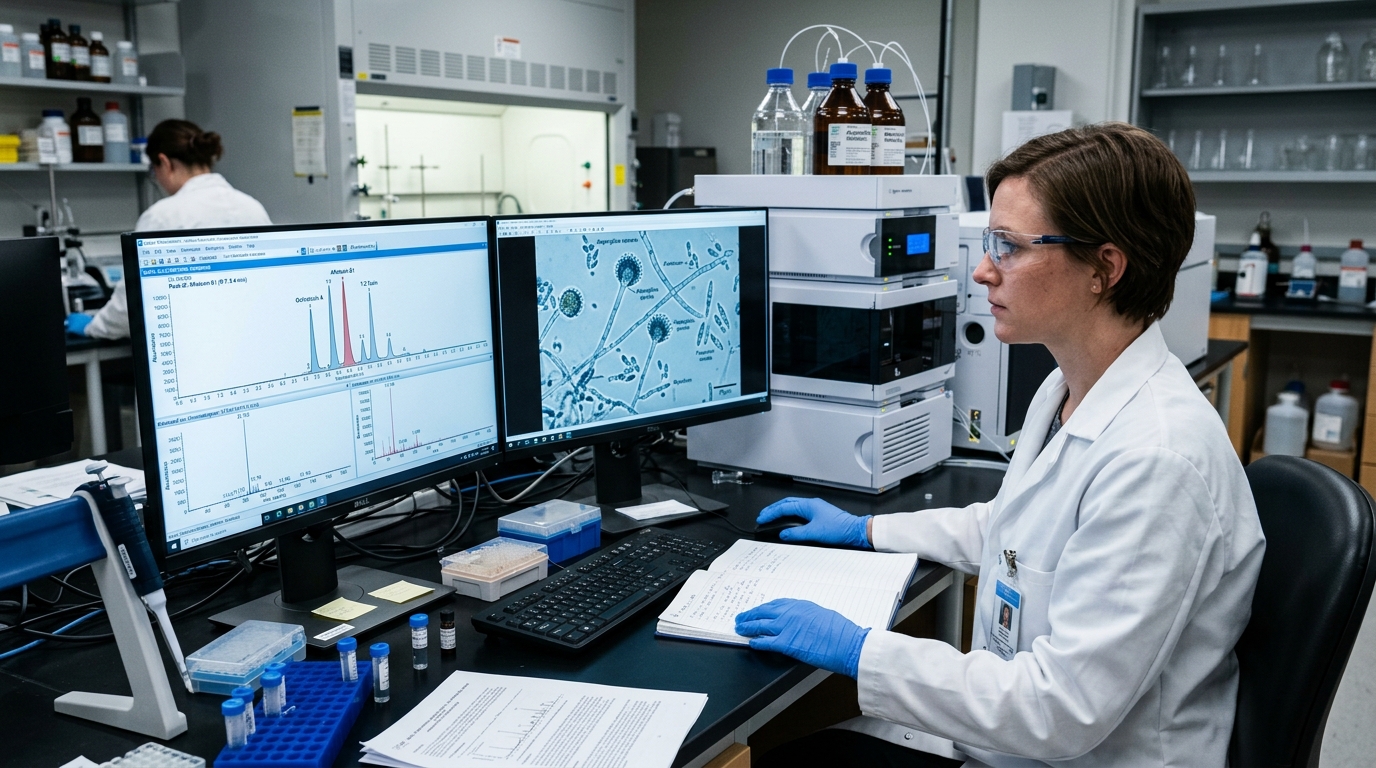
Diagnosing mycotoxicosis requires advanced bio-fluid testing. Environmental physicians order quantitative urinary mycotoxin panels utilizing high-performance Liquid Chromatography-Tandem Mass Spectrometry (LC-MS/MS). These calibrated panels measure excreted concentrations of Ochratoxin A (OTA), Trichothecenes, Aflatoxin B1/M1, and Gliotoxin in parts per billion (ppb) or nanograms.
Diagnosing mycotoxicosis requires advanced bio-fluid testing. Environmental physicians order quantitative urinary mycotoxin panels utilizing high-performance Liquid Chromatography-Tandem Mass Spectrometry (LC-MS/MS).
These calibrated panels measure excreted concentrations of Ochratoxin A (OTA), Trichothecenes, Aflatoxin B1/M1, and Gliotoxin in parts per billion (ppb) or nanograms per gram of creatinine. Elevated urinary mycotoxin levels provide empirical proof of active internal bio-accumulation resulting from ongoing environmental exposure.
Environmental Remediation & Source Eradication Protocols
Because mycotoxins are non-living chemical toxins that adhere to dust particles and aerosolize independently of intact fungal spores, basic cleaning is completely ineffective. Certified environmental restoration requires: (1) establishing negative-air containment (-5 Pa) with exhaust HEPA filtration, (2) physical removal and disposal.
Because mycotoxins are non-living chemical toxins that adhere to dust particles and aerosolize independently of intact fungal spores, basic cleaning is completely ineffective.
Certified environmental restoration requires: (1) establishing negative-air containment (-5 Pa) with exhaust HEPA filtration, (2) physical removal and disposal of all colonized organic building materials, (3) comprehensive micro-cleaning of all non-porous surfaces using quaternary ammonium surfactants and botanical biocides, and (4) deep air-washing utilizing high-volume HEPA air scrubbers and hydroxyl atmospheric oxidizers to break down chemical toxin structures.