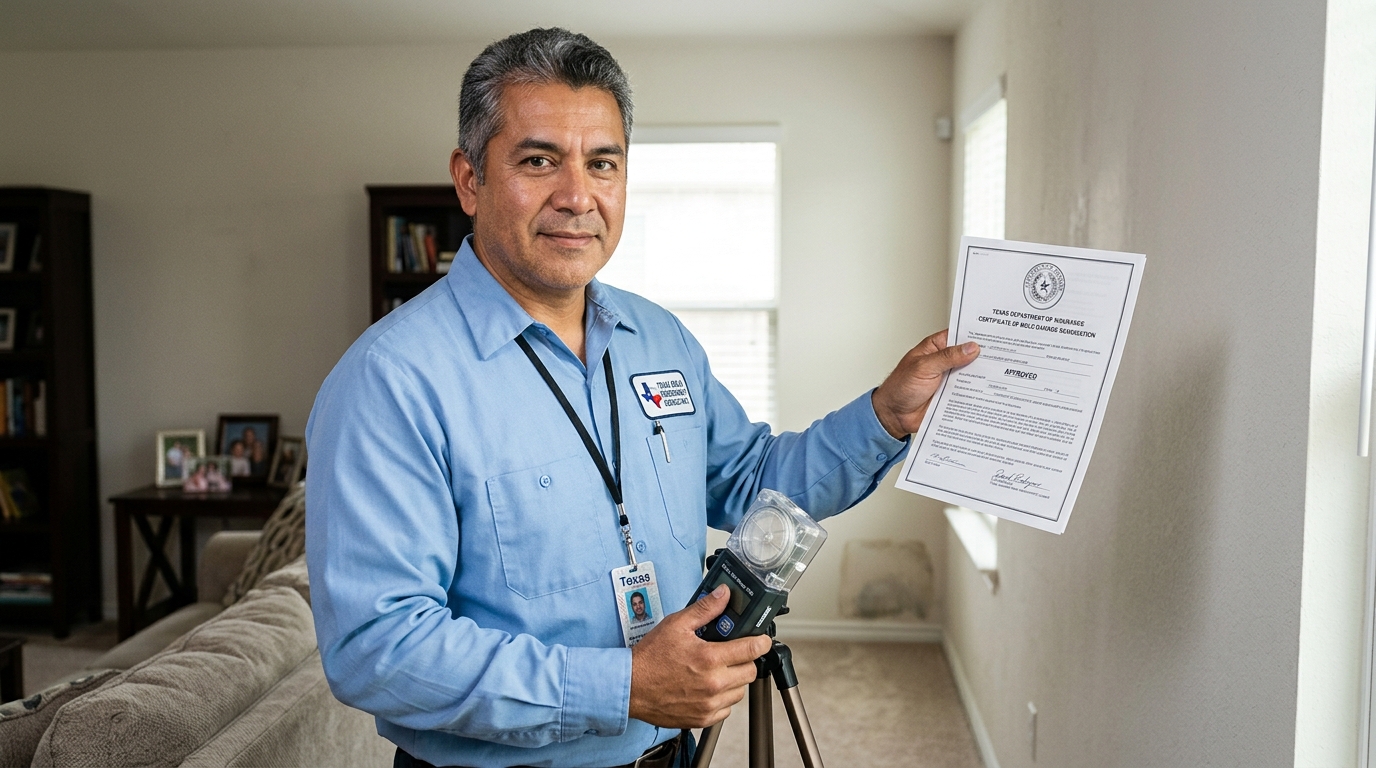
Statutory Separation of Assessor & Remediation Contractor Under Texas Law
Texas enforces some of the strictest consumer protection mold regulations in the United States. Under Texas Occupations Code Chapter 1958, any project involving visible mold exceeding 25.0 contiguous square feet mandates the separation of professional assessment and remediation. A single company is.
Texas enforces some of the strictest consumer protection mold regulations in the United States. Under Texas Occupations Code Chapter 1958, any project involving visible mold exceeding 25.0 contiguous square feet mandates the separation of professional assessment and remediation.
A single company is legally prohibited from performing both mold testing and remediation on the same real estate project.
Property owners must hire a licensed Mold Assessment Consultant (MAC) to produce a formal written Mold Remediation Protocol, and a separate licensed Mold Remediation Contractor (MRC) to execute the physical deconstruction and antimicrobial cleaning.
The 4-Stage Protocol to Obtain TDI Form MDR-1
Securing a valid Form MDR-1 requires strict adherence to the statutory timeline: (1) Protocol Generation: The licensed assessor inspects the property, establishes moisture parameters using FLIR thermal cameras, and publishes the protocol. (2) Containment & Remediation: The contractor erects negative-air poly airlocks.
Securing a valid Form MDR-1 requires strict adherence to the statutory timeline: (1) Protocol Generation: The licensed assessor inspects the property, establishes moisture parameters using FLIR thermal cameras,
and publishes the protocol. (2) Containment & Remediation: The contractor erects negative-air poly airlocks (-5 Pa) and extracts contaminated building materials. (3) Post-Remediation Assessment (PRA): The independent assessor inspects the containment zone and collects clearance air cassettes. (4) Certificate Execution: Within 10 calendar days of passing clearance,
the contractor executes Form MDR-1 and delivers it to the property owner.
Protecting Home Sellers on the TREC Seller Disclosure Notice
Under Texas Property Code Section 5.008, home sellers must disclose all known structural defects on the Texas Real Estate Commission (TREC) Seller's Disclosure Notice. Uncertified handyman repairs or DIY bleach treatments remain legally actionable latent defects that expose sellers to treble damages.
Under Texas Property Code Section 5.008, home sellers must disclose all known structural defects on the Texas Real Estate Commission (TREC) Seller's Disclosure Notice.
Uncertified handyman repairs or DIY bleach treatments remain legally actionable latent defects that expose sellers to treble damages under the Texas Deceptive Trade Practices Act (DTPA).
When a seller attaches a signed TDI Form MDR-1 along with passing PRV laboratory spore reports, Texas law prohibits insurance carriers from charging property surcharges or denying homeowner underwriting coverage based on past mold history.
Escrow Clearance & Title Transfer Acceleration
In fast-paced Texas metro escrow closings, mortgage underwriters require certified documentation before releasing clear-to-close loan documents. Providing a certified Form MDR-1 satisfies conventional, FHA, and VA lender repair contingencies instantaneously. Title closing officers in Harris, Dallas, Tarrant, and Travis Counties utilize the.
In fast-paced Texas metro escrow closings, mortgage underwriters require certified documentation before releasing clear-to-close loan documents. Providing a certified Form MDR-1 satisfies conventional, FHA, and VA lender repair contingencies instantaneously.
Title closing officers in Harris, Dallas, Tarrant, and Travis Counties utilize the state certificate to ensure clean title insurance policies without environmental exceptions, enabling closings to proceed on schedule without five-figure escrow holdbacks.