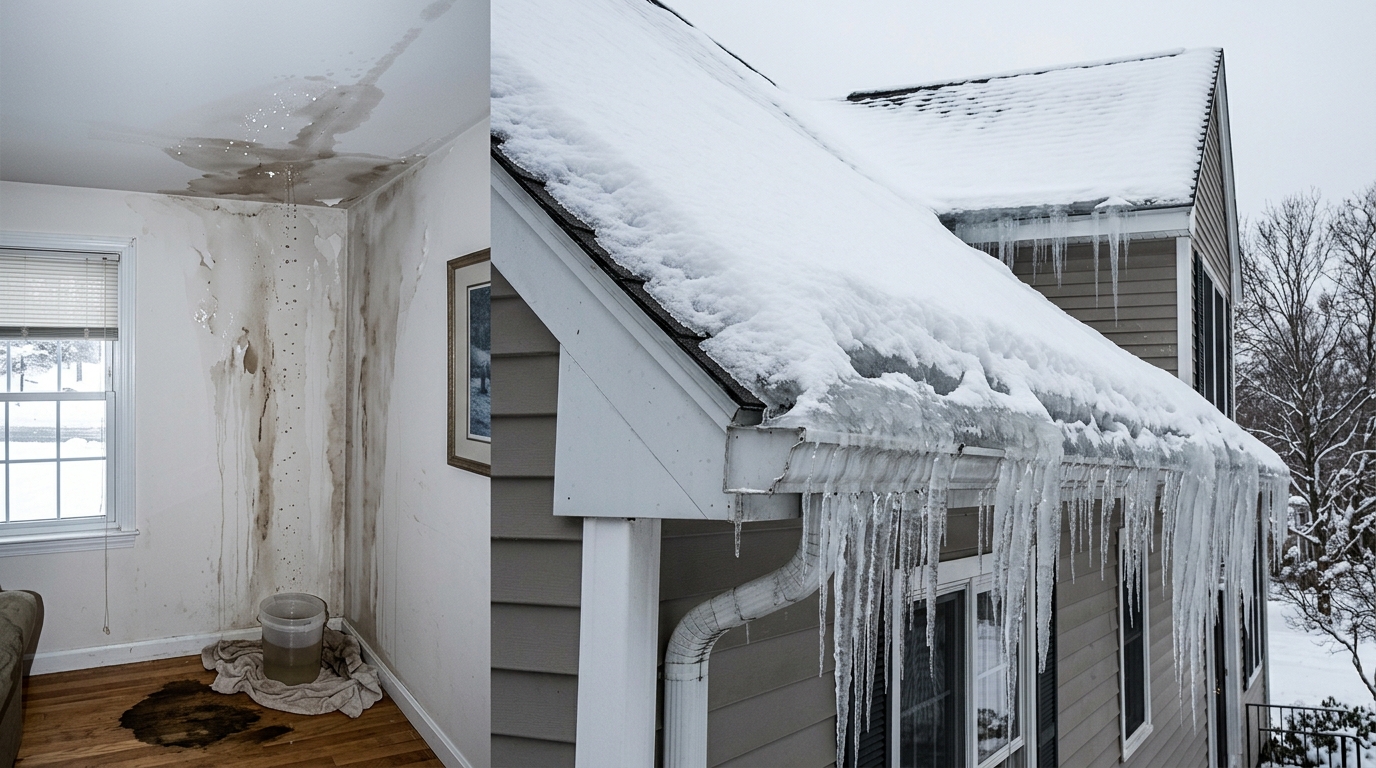
Thermodynamics of an Ice Dam: Thermal Bypasses & The Eave Freeze Cycle
An ice dam is not simply a roofing problem; it is a symptom of building envelope failure and attic thermal leakage. The formation process follows precise thermodynamic laws:
- Attic Thermal Bypasses: Warm indoor air escapes into the attic space through unsealed penetrations: recessed lighting cans, attic hatch access doors, plumbing vent stacks, and chimney chases. Attic temperatures climb above 32°F even when outdoor temperatures are 15°F.
- Mid-Roof Snowmelt: Escaping heat warms the upper roof sheathing, melting the bottom layer of snowpack. Meltwater flows downward beneath the snow blanket toward the roof perimeter.
- Eave Freeze Barrier: Because the eaves and gutters extend beyond the exterior wall plane, they receive no heat from the living space below, remaining at outdoor freezing temperatures. When meltwater reaches the cold eave, it freezes instantly into solid ice.
- Capillary Shingle Backflow: Over several days of freeze-thaw cycles, a massive ice ridge builds 6 to 18 inches high along the gutter line. Water pooling behind the dam backs up under overlapping asphalt shingles, penetrating roofing felt seams and plywood sheathing joints.
Water Intrusion Pathways: Exterior Wall Cavities, Plaster & Blown Insulation
Once meltwater penetrates beneath roofing shingles, it follows downward gravity paths through structural cavities:
- Roof Sheathing Delamination: Moisture saturates plywood or oriented strand board (OSB) decking. Cyclic freezing causes wood fibers to swell and delaminate, rotting roof framing nails and causing shingle tabs to detach.
- Insulation Compression: Water drips onto attic floor insulation, compacting cellulose or fiberglass batts and destroying their R-value, which further increases heat loss and accelerates the ice dam cycle.
- Exterior Wall Cavity Flooding: Water travels down exterior wall top plates, entering wall cavities behind lath-and-plaster or drywall. It saturates framing studs, window headers, and exterior siding sheathing without showing immediate front-facing stains until microbial growth has colonized hundreds of square feet.
Cryogenic Dry Ice Blasting & Attic Rafter Remediation
Remediating mold colonies on attic roof decking and structural rafters cannot be accomplished with hand wiping or consumer chemical sprays. Certified ANSI/IICRC S520 contractors deploy cryogenic dry ice blasting:
- Sub-Zero Pellet Acceleration: Technicians accelerate solid carbon dioxide (CO2) dry ice pellets at -109°F (-78.5°C) using compressed air at 80 to 140 PSI directly against mold-colonized roof sheathing and rafters.
- Micro-Thermal Shock & Sublimation: Upon impact, the freezing pellets induce micro-thermal shock, fracturing fungal hyphae roots embedded deep within the wood grain. The CO2 instantly sublimates into gas, expanding 800 times in volume and lifting microbial cellular structures clean off the timber without leaving secondary chemical waste.
- Clearance Air Scrubbing: Continuous HEPA negative-air filtration chambers maintain clean air quality, capturing dislodged spores and venting particulates safely outside the living envelope.
Forensic Moisture Profiling & Cavity Drying Protocol
Drying water-damaged exterior walls and ceilings after an ice dam breach requires sophisticated structural restoration equipment:
- FLIR Thermal Infrared Scanning: Technicians scan exterior wall perimeters and ceiling intersections to identify temperature depressions indicative of trapped moisture behind plaster or drywall.
- Deep-Wall Injectidry Air Distribution: Technicians drill precision 3/8-inch relief holes behind baseboards, inserting specialized tubing that forces heated, ultra-dry air directly into wet wall cavities.
- High-Capacity Desiccant Dehumidifiers: In cold winter environments where traditional refrigerant dehumidifiers lose efficiency, industrial desiccant dehumidifiers are deployed to pull moisture out of structural framing lumber at sub-zero dew points.
Xactimate® Insurance Claim Optimization for Ice Dam Losses
Homeowners insurance policies (HO-3/HO-5) cover internal water damage caused by ice dam penetration under the peril of 'Weight of Ice and Snow' and accidental water discharge. However, carriers routinely deny coverage for exterior roof ice removal (steaming) while agreeing to pay for interior structural repairs.
Our certified restoration specialists provide complete, itemized claims documentation in Xactimate® to maximize policy benefits:
WTR DRY- Controlled selective removal of water-damaged drywall ceilings and exterior wall insulation.WTR DEHUMD- Industrial desiccant and LGR dehumidification rental and operational monitoring.WTR BLAST- Cryogenic dry ice blasting of fungal colonies on structural roof trusses and OSB sheathing.WTR BIO- Application of EPA-registered botanical antimicrobials across structural timber.LAB PRV- Independent third-party Post-Remediation Verification clearance testing certifying zero fungal spore contamination.