3 Regional Environmental Hazards & Structural Threats in San Diego
Emergency mold remediation in San Diego, CA requires rapid containment and psychrometric drying within 24 to 48 hours of water intrusion. Certified IICRC S520 teams deploy negative-air scrubbers and thermal imaging across San Diego County to extract moisture safely.
Properties across San Diego encounter acute microbial threats driven by dense coastal marine layer fog dampness, continuous high relative humidity above 75%, and crawlspace fungal growth.
Local construction typologies, including coastal stucco over timber framing, post-war mid-century single-story ranches, and raised subfloor crawlspaces, demand immediate structural containment to prevent widespread spore colonization.
Field operations across San Diego County are shaped by local geological conditions, specifically coastal terrace sandstone, weathered marine sedimentary bedrock, and steep canyon alluvial wash channels.
Major transit routes including I-5 coastal freeway, I-8 corridor, I-15 inland artery, SR 163 Cabrillo Freeway, and Pacific Coast Highway provide rapid regional access.
Emergency crews reach properties near Balboa Park, Mission Bay, Point Loma bluffs, La Jolla, and Downtown San Diego Gaslamp Quarter within 15 to 30 minutes.
When moisture breaches building envelopes, porous drywall wicks water rapidly into wall assemblies. Ambient indoor humidity climbing past 60% accelerates toxigenic fungal propagation across structural subflooring.
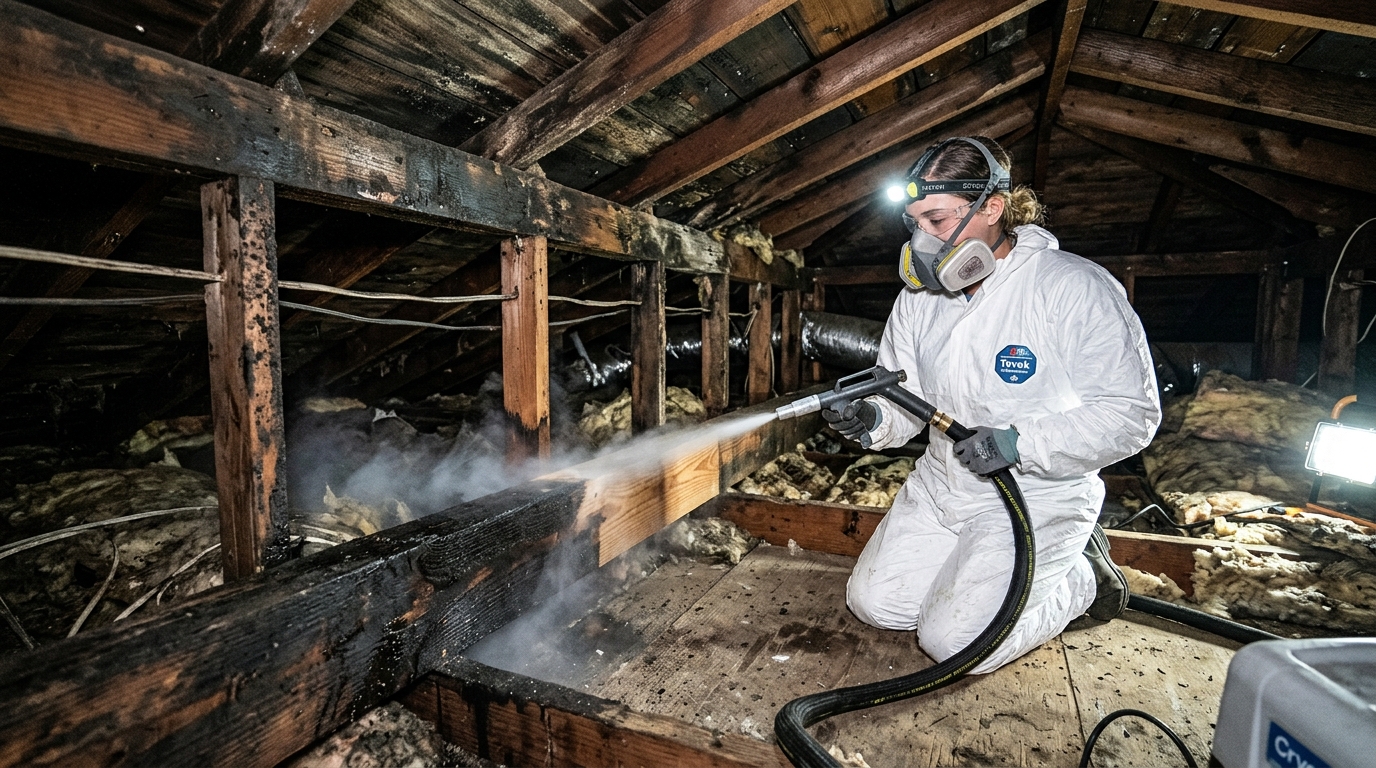
Certified technicians execute precision material cuts, apply EPA-registered antimicrobials, and run commercial desiccant dehumidifiers.
Technicians lower Wood Moisture Equivalent below 14.0% within 24 to 72 hours, ensuring compliance with California Health and Safety Code Section 17920.3, Senate Bill SB 655 habitability rules, and Cal/OSHA standards.
4 Standardized Inspection & Testing Protocols in San Diego
Certified mold assessment and structural diagnostic procedures deployed across residential and commercial properties in San Diego follow strict ANSI/IICRC S520 standards. Calibrated instrumentation identifies hidden moisture anomalies and quantifies airborne fungal particulate loads against outdoor baseline controls.
- FLIR Thermal Infrared Moisture Mapping: High-resolution thermography identifies temperature differentials created by evaporative cooling inside foundation brick and drywall cavities.
- Air-O-Cell Bioaerosol Spore Trap Sampling: Calibrated vacuum air pumps draw precisely 15.0 liters per minute for 5 minutes through sealed cassettes to quantify airborne spore counts against outdoor baselines.
- Direct Bio-Tape Microscopic Analysis: Sterile tape-lift samples verify localized fungal colonization on joists, differentiating toxigenic mold from cosmetic dust minerals.
- Post-Remediation Verification (PRV) Documentation: Independent third-party AIHA-accredited laboratory reports deliver clear-to-close documentation for real estate transactions, lenders, and insurance adjusters.
3 Regional Environmental Emergency Coverage Zones in California
Our emergency response fleet coordinates 24/7 moisture extraction, negative-air containment, and ANSI/IICRC S520 remediation across all municipal sectors in California. Certified technicians deploy within 15 to 30 minutes, maintaining synchronized radio dispatch between central operations and regional rapid response stations.
During severe plumbing line breaks or storm inundation, field crews coordinate certified Anaheim mold testing protocols. Similarly, properties facing foundation moisture rely on our Antioch thermal moisture detection specialists.
Because airborne fungal spores spread across ventilation plenums, our inspectors partner with Chico environmental hygienists to verify containment. We also execute timber decontamination backed by our Chino mitigation crews and Alhambra inspectors.
Whether extracting Category 3 blackwater or sealing crawlspaces, our Burbank remediation network provides immediate help. This protection is reinforced through our Carson field stations and the Clovis emergency response team.
Frequently Asked Environmental Questions in San Diego
What is the average cost of certified mold remediation in San Diego, CA?
Certified mold remediation in San Diego, CA ranges between $1,550 and $5,100 depending on structural contamination boundaries. Localized drywall containment averages $1,550 to $2,200, while extensive structural timber bio-washing and negative-air filtration reach $3,500 to $5,100.
All restoration billing is itemized using Xactimate industry software to match exact insurance carrier guidelines, eliminating out-of-pocket costs for covered claims.
How long does professional structural drying take after a California water leak?
Professional structural drying takes exactly 24 to 72 hours when industrial low-grain refrigerant dehumidifiers and high-velocity air movers operate continuously. Certified technicians monitor moisture levels daily until Wood Moisture Equivalent drops below 14.0%.
Daily psychrometric logs record ambient temperature, relative humidity, and grains per pound to certify that subfloors and framing are thoroughly stabilized.
Does homeowners insurance in California cover toxic mold removal?
Homeowners insurance in California covers certified mold remediation when caused directly by a covered sudden accidental water discharge. Independent laboratory Post-Remediation Verification clearance reports provide adjusters with necessary objective documentation.
Restoration teams coordinate directly with insurance carriers under California Health and Safety Code Section 17920.3, Senate Bill SB 655 habitability rules, and Cal/OSHA standards, managing documentation and photo evidence from initial containment to clearance.
We dispatch certified environmental specialists across all California counties. View our Main California State Directory Hub or return to the 50-State Hub Directory.
Read our certified Coastal marine layer fog and window sill moisture protocol.
Explore the solved San Diego coastal marine moisture and crawlspace decontamination case study.