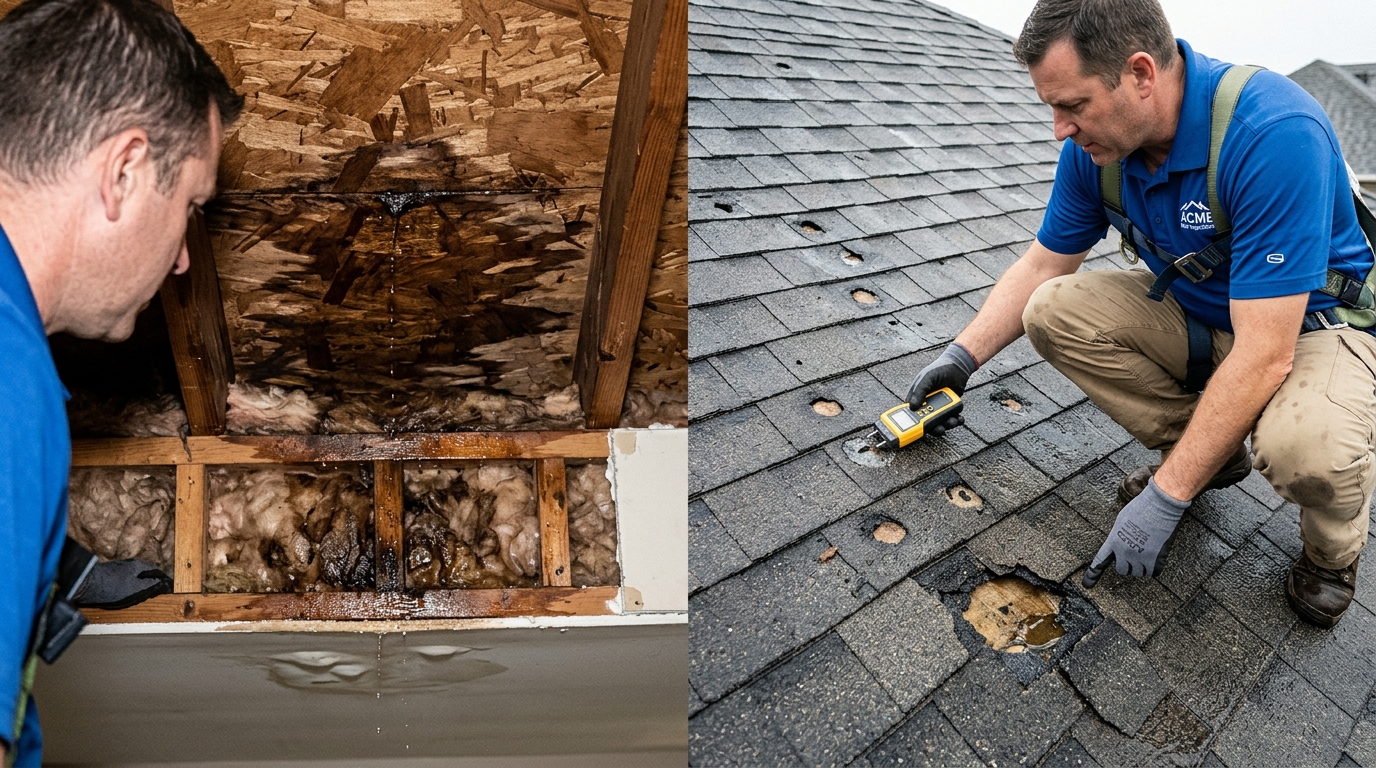
The Hidden Anatomy of Wind-Driven Rain Infiltration
Severe convective storms generate positive windward pressure differentials exceeding 40 pounds per square foot (psf), forcing rainwater horizontally beneath roofing shingles and behind siding claddings. Hail impacts exceeding 1.5 inches in diameter fracture underlying fiberglass asphalt mats without puncturing the top surface.
Severe convective storms generate positive windward pressure differentials exceeding 40 pounds per square foot (psf), forcing rainwater horizontally beneath roofing shingles and behind siding claddings. Hail impacts exceeding 1.5 inches in diameter fracture underlying fiberglass asphalt mats without puncturing the top surface granules immediately.
Over subsequent storm cycles, water enters these fractured zones and travels laterally along plywood decking seams before entering vertical partition walls.
Because modern closed-cell or fiberglass insulation traps moisture against interior wood framing, structural wall cavities remain saturated at 100% relative humidity, creating an invisible incubator for fungal growth.
Non-Invasive Diagnostic Scanning Technologies
Detecting storm-induced hidden wall moisture requires advanced non-destructive diagnostic tools. Certified environmental inspectors conduct comprehensive FLIR thermal imaging surveys under controlled atmospheric conditions to detect subtle evaporative thermal signatures on interior walls and ceilings. Inspectors verify suspected moisture anomalies using dual-depth RF.
Detecting storm-induced hidden wall moisture requires advanced non-destructive diagnostic tools. Certified environmental inspectors conduct comprehensive FLIR thermal imaging surveys under controlled atmospheric conditions to detect subtle evaporative thermal signatures on interior walls and ceilings.
Inspectors verify suspected moisture anomalies using dual-depth RF capacitance moisture meters (such as the Protimeter ReachMaster Pro and Tramex Dec Scanner) capable of measuring sub-surface moisture up to 4 inches deep through ceramic tile, plaster, and multiple drywall layers without surface damage.
Controlled Cavity Depressurization & Spore Containment
When hidden wall cavity mold is detected, opening walls haphazardly disperses billions of toxic fungal spores into living areas. Remediators construct critical containment barriers using 6-mil flame-retardant polyethylene sheeting sealed with heavy-duty zipper access ports. Technicians install negative air machines equipped with 99.
When hidden wall cavity mold is detected, opening walls haphazardly disperses billions of toxic fungal spores into living areas. Remediators construct critical containment barriers using 6-mil flame-retardant polyethylene sheeting sealed with heavy-duty zipper access ports.
Technicians install negative air machines equipped with 99.97% HEPA filtration exhausting outside the building envelope to maintain a continuous -5 Pascal pressure differential. Controlled deconstruction is executed using HEPA-shrouded cutting tools to remove contaminated drywall and wet insulation safely.
Full Structural Decontamination & Reconstruction Clearance
After contaminated building assemblies are removed, technicians scrub exposed wall studs and roof sheathing with EPA-registered botanical antimicrobials. Framing members undergo intensive HEPA vacuuming followed by commercial structural drying until wood moisture content registers below 14.0% WME. Third-party environmental testing specialists collect.
After contaminated building assemblies are removed, technicians scrub exposed wall studs and roof sheathing with EPA-registered botanical antimicrobials. Framing members undergo intensive HEPA vacuuming followed by commercial structural drying until wood moisture content registers below 14.0% WME.
Third-party environmental testing specialists collect quantitative spore trap air cassettes (such as Air-O-Cell) inside the containment zone to certify Post-Remediation Verification (PRV) clearance before reconstruction begins.