3 Structural Hazards: Freeze-Thaw Plumbing Line Splits & Winter Pipe Bursts in Howell
Sub-zero polar vortex temperatures across Howell cause water inside exterior wall plumbing pipes to freeze and expand rapidly. The resulting circumferential pipe ruptures discharge hundreds of gallons of pressurized water into structural wall cavities, requiring immediate containment to prevent widespread fungal propagation.
Freezing winds penetrate uninsulated rim joists across Howell, freezing concealed copper plumbing lines.
Pressurized water floods wall insulation, subflooring, and finished ceilings within minutes of pipe thawing.
Properties designed with Bungalow concrete block basements, mid-century brick ranches, and lakefront wood cottages suffer severe subfloor timber saturation over cold Glacial sandy loam, heavy lake-bed clay, and poorly drained muck soils.
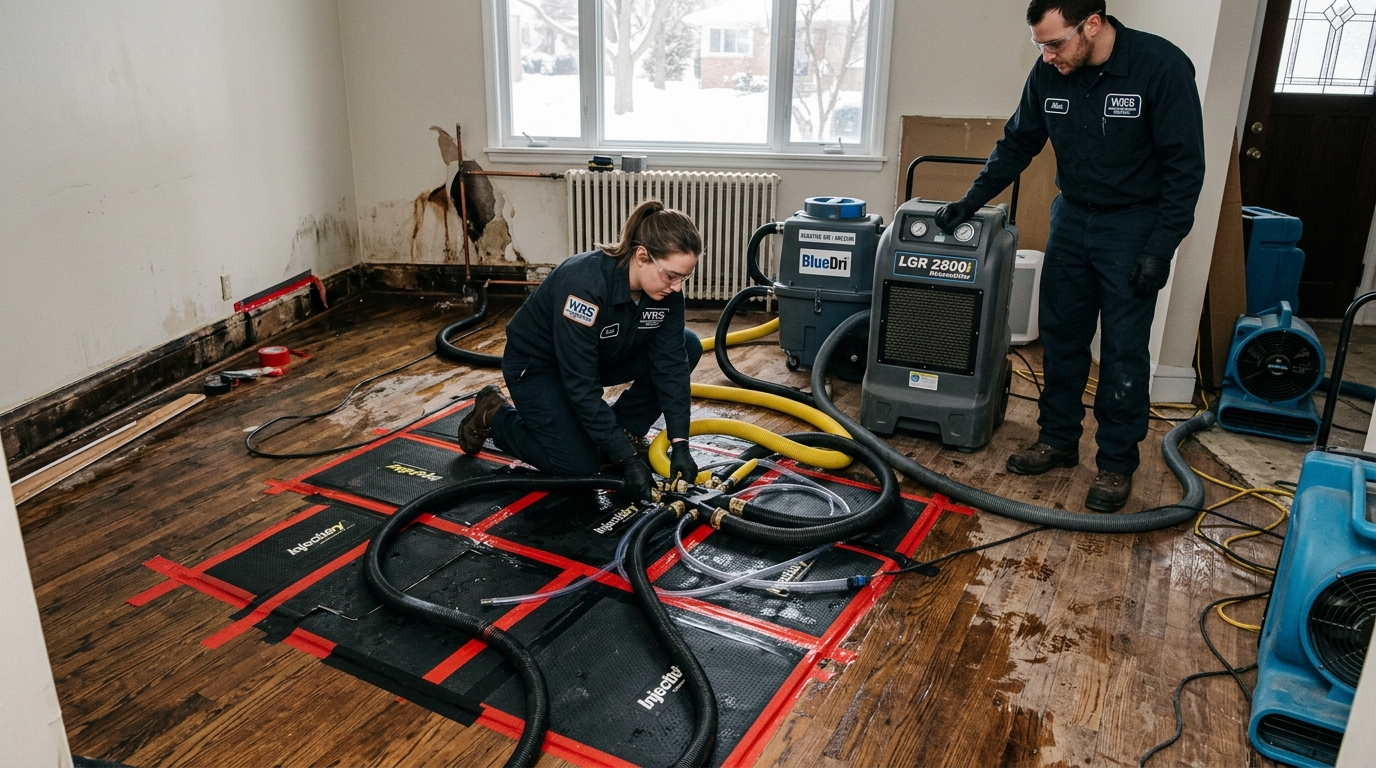
Restoration teams shut off water mains, execute targeted wall cavity flood cuts, and remove saturated insulation.
Industrial desiccant dehumidifiers run continuous air exchanges to dry structural framing in compliance with Michigan Compiled Laws § 554.139 (Covenants of Mutual Habitability in Residential Leases).
4 Standardized Inspection & Testing Protocols in Howell
Emergency structural drying and freeze-thaw pipe burst remediation across Howell properties adhere strictly to ANSI/IICRC S520 standards. Technicians establish rapid containment and continuous desiccant dehumidification to stabilize moisture within 72 hours.
- Emergency Thermal Moisture Mapping: FLIR infrared thermography maps the full perimeter of water migration through walls and subfloors.
- Pressurized Water Extraction: Industrial extractors remove standing water from hardwood flooring, carpets, and structural framing.
- Directed In-Wall Cavity Drying: High-velocity air injectors force warm, dry air into exterior wall framing cavities through discrete access holes.
- Daily Psychrometric Moisture Verification: Digital moisture meters track Wood Moisture Equivalent daily until structural timbers reach safe baselines.
3 Regional Environmental Emergency Coverage Zones in Michigan
Our emergency response fleet coordinates 24/7 moisture extraction, negative-air containment, and ANSI/IICRC S520 remediation across all municipal sectors in Michigan. Certified technicians deploy within 15 to 30 minutes, maintaining synchronized radio dispatch between central operations and regional rapid response stations.
During severe plumbing line breaks or storm inundation, field crews coordinate certified South Lyon mold testing protocols. Similarly, properties facing foundation moisture rely on our Southfield thermal moisture detection specialists.
Because airborne fungal spores spread across ventilation plenums, our inspectors partner with Niles environmental hygienists to verify containment. We also execute timber decontamination backed by our Bay City mitigation crews and Cadillac inspectors.
Whether extracting Category 3 blackwater or sealing crawlspaces, our Dearborn remediation network provides immediate help. This protection is reinforced through our Mount Clemens field stations and the Norton Shores emergency response team.
Frequently Asked Environmental Questions in Howell
What steps are necessary after a winter freeze pipe burst in Howell, MI?
The first essential step after a pipe burst in Howell is shutting off the main water supply valve immediately. Next, property owners should call certified emergency restoration specialists to extract standing water and set up containment before mold germinates.
Documenting water migration paths with photos before moving soaked personal property assists insurance adjusters in processing claims efficiently.
How long does it take to dry structural timber after a winter pipe rupture?
Drying structural framing timbers in Howell takes exactly 48 to 72 hours under continuous commercial desiccant dehumidification. Technicians operate high-velocity centrifugal air movers until moisture meters register timber moisture content strictly below 14.0%.
Prematurely terminating drying equipment traps residual moisture inside wall cavities, causing latent mold growth and floor buckling months later.
Does homeowners insurance in Michigan cover freeze-thaw plumbing line splits?
Homeowners insurance in Michigan covers water damage from burst frozen pipes provided the building heating system was maintained at reasonable levels. Carriers reimburse emergency water extraction, structural drying, and drywall reconstruction under standard provisions.
Our restoration team works directly with insurance adjusters under Michigan Compiled Laws § 554.139 (Covenants of Mutual Habitability in Residential Leases), submitting itemized Xactimate estimates for all drying procedures.
We dispatch certified environmental specialists across all Michigan counties. View our Main Michigan State Directory Hub or return to the 50-State Hub Directory.
Read our certified Deep freeze pipe burst 72-hour drying timeline and mold prevention guide.
Explore the solved Freeze-thaw exterior wall plumbing line rupture drying case study.