Phase 1 (Hours 0 to 6): Immediate Emergency Stabilization
The first six hours following a post-thaw pipe burst determine whether building assemblies can be saved or must be gutted entirely. Homeowners must shut off the main water supply valve immediately and deactivate electrical circuits supplying flooded zones to prevent electrocution hazards.
The first six hours following a post-thaw pipe burst determine whether building assemblies can be saved or must be gutted entirely. Homeowners must shut off the main water supply valve immediately and deactivate electrical circuits supplying flooded zones to prevent electrocution hazards.
Certified emergency response units dispatch with commercial truck-mounted extraction units producing vacuum lift exceeding 14 inches of mercury (inHg).
Technicians extract standing water from carpets, subfloors, and concrete slabs, removing up to 90% of free unbonded liquid water before it wicks deeper into structural framing assemblies.
Phase 2 (Hours 6 to 24): Cavity Breaching & Targeted Deconstruction
Water from burst pipes flows downward along plumbing chases and electrical conduits, accumulating inside interior partition wall cavities and ceiling bays. Technicians deploy calibrated pinless moisture scanners to map wet perimeters accurately. Remediators remove baseboards and drill 5/8-inch relief holes into wall.
Water from burst pipes flows downward along plumbing chases and electrical conduits, accumulating inside interior partition wall cavities and ceiling bays. Technicians deploy calibrated pinless moisture scanners to map wet perimeters accurately.
Remediators remove baseboards and drill 5/8-inch relief holes into wall cavities to introduce high-velocity heated air.
Non-salvageable wet assemblies (such as saturated drywall ceilings sagging under water weight, paper-backed insulation batts, and warped particleboard underlayment) are cut and bagged under controlled conditions to expose structural joists to direct dehumidification.
Phase 3 (Hours 24 to 48): Industrial Convective Drying Grid Setup
Stopping fungal spore germination requires dropping relative humidity below 30% and pulling moisture out of dense structural framing lumber (frequently required during polar freeze surges across Buffalo, Rochester, Syracuse, and Albany). Certified crews deploy specialized Low Grain Refrigerant (LGR) dehumidifiers, commercial desiccant.
Stopping fungal spore germination requires dropping relative humidity below 30% and pulling moisture out of dense structural framing lumber (frequently required during polar freeze surges across , , , and ).
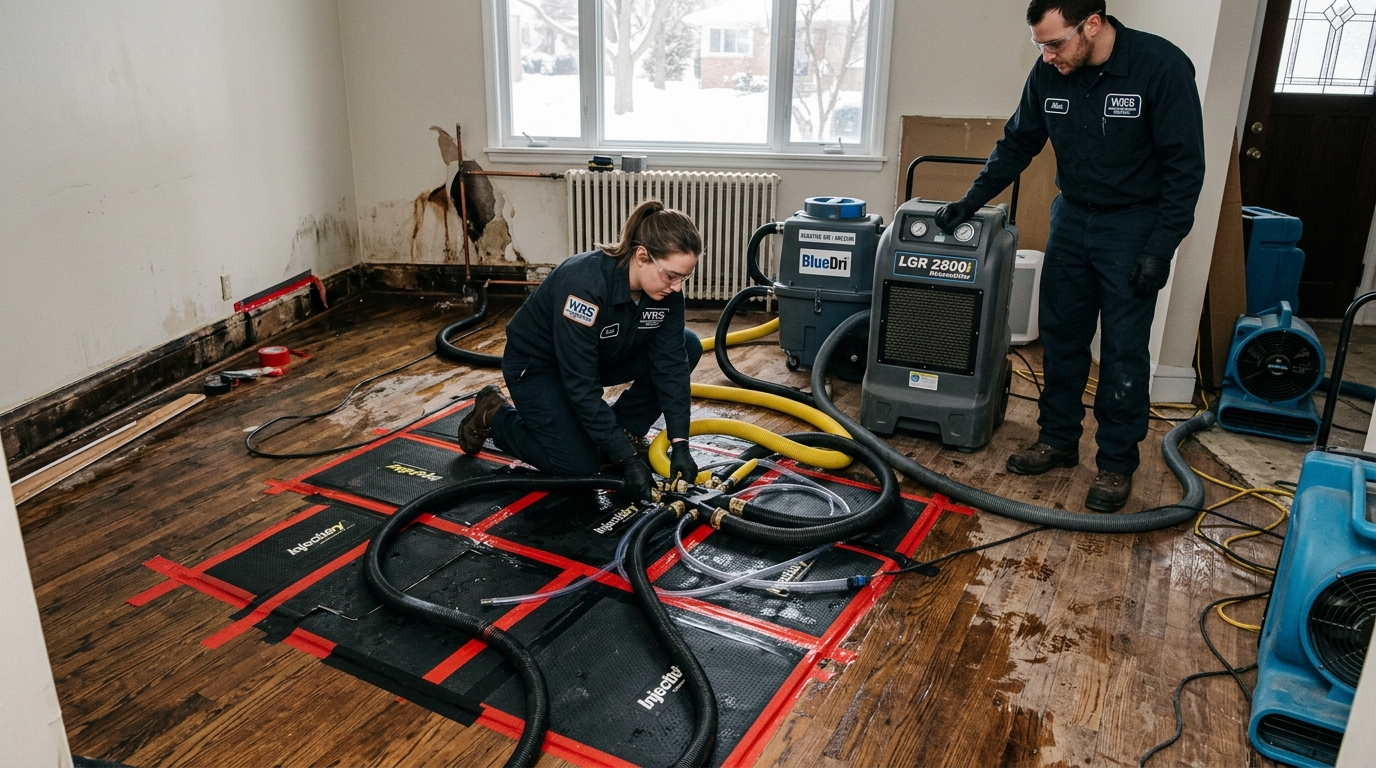
Certified crews deploy specialized Low Grain Refrigerant (LGR) dehumidifiers, commercial desiccant dryers, and high-velocity centrifugal air movers delivering over 250 CFM per 10 linear feet of wall space.
Technicians set up negative-pressure injectidry floor mats directly over wet hardwood and subfloors to pull trapped capillary moisture upward through hardwood plank seams without causing cupping or crowning.
Phase 4 (Hours 48 to 72+): Moisture Equilibrium Clearance & Verification
Throughout the drying cycle, technicians record psychrometric drying logs tracking ambient temperature, relative humidity, dew points, and grains per pound (GPP) differentials between processed and exhaust air streams. Fungal growth is prevented when framing lumber moisture content drops below 14.
Throughout the drying cycle, technicians record psychrometric drying logs tracking ambient temperature, relative humidity, dew points, and grains per pound (GPP) differentials between processed and exhaust air streams.
Fungal growth is prevented when framing lumber moisture content drops below 14.0% WME and subfloor moisture content returns within 2.0% to 4.0% of pre-loss baseline standards. Technicians apply broad-spectrum antimicrobial botanical washes across all exposed framing cavities before approving structural reconstruction.