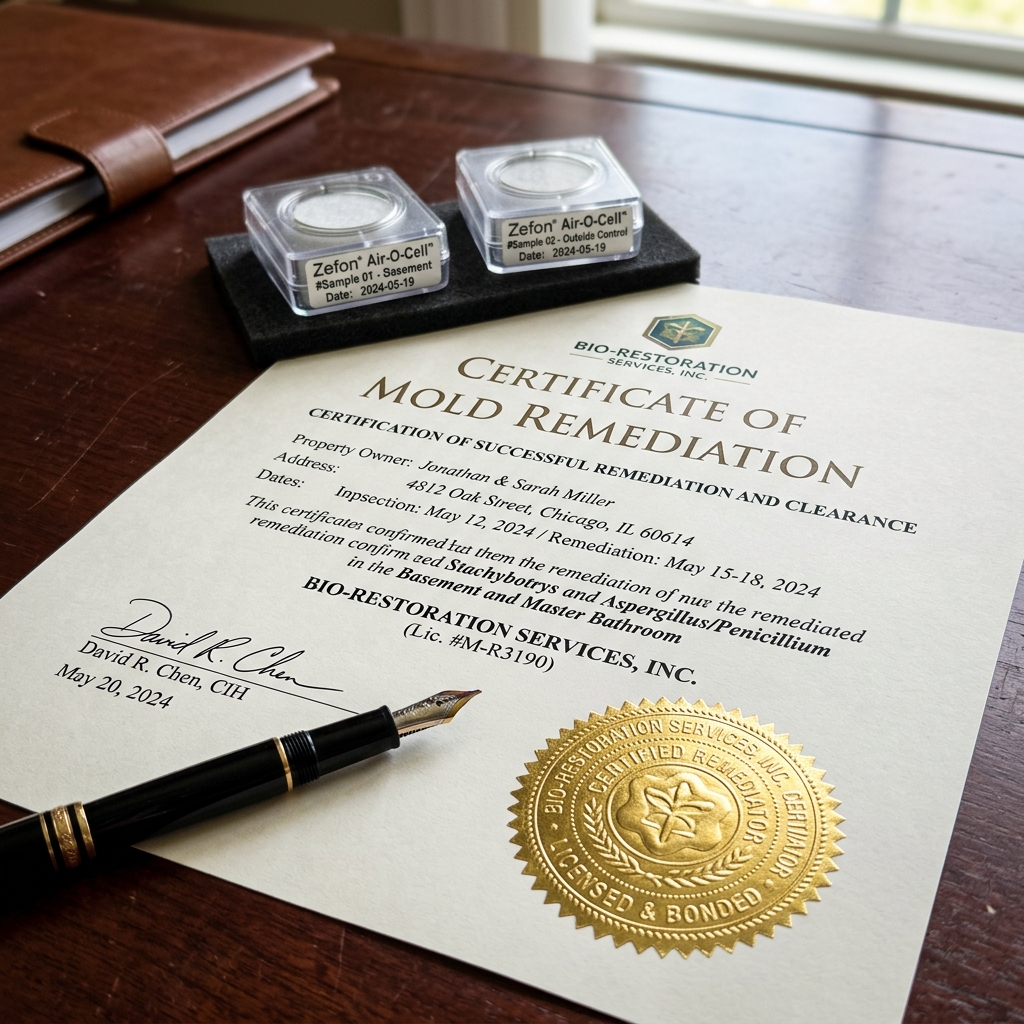
1. What Is a Certificate of Mold Remediation (CMDR)?
A Certificate of Mold Remediation (CMDR, such as the Texas Department of Insurance Form MDR-1) represents state-sanctioned legal proof that professional remediation eliminated fungal colonization in accordance with statutory guidelines. Licensed mold remediation contractors sign and issue this formal compliance document within.
A Certificate of Mold Remediation (CMDR, such as the Texas Department of Insurance Form MDR-1) represents state-sanctioned legal proof that professional remediation eliminated fungal colonization in accordance with statutory guidelines.
Licensed mold remediation contractors sign and issue this formal compliance document within 10 business days of passing independent Post-Remediation Verification (PRV) testing.
The certificate attests under penalty of law that all underlying water intrusion vectors were permanently repaired and affected building substrates were decontaminated to baseline clean ecology.
Real estate title companies, closing attorneys, and mortgage underwriters require a recorded CMDR to remove environmental encumbrances and approve clear title transfer during property transactions.
2. Clearing Property Stigmatization on CLUE Insurance Databases
Property insurance underwriters record all historical water and mold damage claims in the Comprehensive Loss Underwriting Exchange (CLUE) database, generating risk flags that cause premium surcharges or policy denials for prospective home buyers. Providing a recorded Certificate of Mold Remediation removes historical.
Property insurance underwriters record all historical water and mold damage claims in the Comprehensive Loss Underwriting Exchange (CLUE) database, generating risk flags that cause premium surcharges or policy denials for prospective home buyers.
Providing a recorded Certificate of Mold Remediation removes historical claims flags from insurer underwriting algorithms, proving that all previous moisture damage was resolved by licensed environmental specialists.
A valid CMDR restores property insurability by ensuring new buyers qualify for standard HO-3 homeowner insurance policies at standard market rates, eliminates title stigma by proving to title officers that no unresolved environmental liabilities exist,
and protects appraised valuations by preventing real estate appraisers from applying 10% to 20% environmental stigma discounts.
3. Legal Safe Harbor Protections for Sellers and Landlords
Property owners who obtain a certified CMDR receive statutory legal safe harbor protections against future buyer and tenant lawsuits under state environmental laws. In regulated states (including Texas, Florida, and New York), delivering a signed Certificate of Mold Remediation creates a statutory.
Property owners who obtain a certified CMDR receive statutory legal safe harbor protections against future buyer and tenant lawsuits under state environmental laws.
In regulated states (including Texas, Florida, and New York), delivering a signed Certificate of Mold Remediation creates a statutory legal presumption that the seller did not conceal environmental defects.
This legal shield insulates sellers against post-closing claims alleging undisclosed toxic mold exposure, barring buyers from filing fraudulent concealment lawsuits regarding previously remediated areas.
4. The Mandatory Two-Party Protocol to Secure a Signed CMDR
State environmental statutes enforce strict separation of duties between mold assessment consultants and remediation contractors to eliminate conflicts of interest. First, an independent licensed Mold Assessment Consultant (MAC) writes an initial remediation protocol and collects baseline spore trap samples. under certified ANSI/IICRC.
Second, an independent licensed mold remediation contractor executes negative-air containment, HEPA filtration, and structural cleaning according to the engineer's protocol.
The assessment consultant re-inspects the containment chamber, issuing a formal Clearance Certificate that authorizes the contractor to execute and file the official CMDR document within statutory deadlines.
5. The Critical Role of AIHA-Accredited Spore Trap Testing
Securing environmental clearance requires rigorous bioaerosol air testing analyzed by an AIHA-accredited laboratory under strict chain of custody. Independent consultants collect calibrated air samples at 15.0 liters per minute across all containment zones and living areas, comparing indoor fungal concentrations directly against.
Securing environmental clearance requires rigorous bioaerosol air testing analyzed by an AIHA-accredited laboratory under strict chain of custody. Independent consultants collect calibrated air samples at 15.0 liters per minute across all containment zones and living areas, comparing indoor fungal concentrations directly against outdoor baseline controls.
Passing clearance criteria require total indoor spore counts to remain statistically lower than outdoor baseline levels, with zero elevated indicator species (including Stachybotrys, Chaetomium, and Trichoderma). The accredited laboratory certificate provides the scientific foundation supporting the signed CMDR compliance document.
6. Recording the CMDR with County Property Deed Records
Filing the Certificate of Mold Remediation with county deed recording offices creates a permanent public record that clears property title history permanently. Real estate title attorneys attach the recorded CMDR document to title insurance policies, ensuring future buyers and lenders receive verified.
Filing the Certificate of Mold Remediation with county deed recording offices creates a permanent public record that clears property title history permanently.
Real estate title attorneys attach the recorded CMDR document to title insurance policies, ensuring future buyers and lenders receive verified environmental proof during title searches.
Recording the certificate protects long-term property equity and eliminates buyer resistance during future real estate transactions, ensuring transactions close without environmental delays.
7. Resolving Title Insurance Exceptions and Municipal Environmental Flags
Title insurance underwriters examine municipal code enforcement records and public property databases during preliminary title commitments to identify historical environmental infractions. When municipal health departments or county building authorities log past biological contamination complaints, title companies issue mandatory closing exceptions that halt.
Title insurance underwriters examine municipal code enforcement records and public property databases during preliminary title commitments to identify historical environmental infractions. When municipal health departments or county building authorities log past biological contamination complaints, title companies issue mandatory closing exceptions that halt real estate settlement.
Recording an official Certificate of Mold Remediation (CMDR) signed by a state-licensed mold remediation contractor extinguishes municipal code compliance holds immediately. Title officers review the recorded document to remove all environmental schedule exceptions, issuing standard marketable title insurance policies without underwriting delays.
8. Frequently Asked Questions Regarding CMDR Compliance Documents
How long does a Certificate of Mold Remediation remain legally valid? A recorded CMDR provides permanent legal safe harbor protection for historical remediation events, remaining valid on county deed records indefinitely provided no new moisture intrusions occur.
Can a homeowner write their own Certificate of Mold Remediation? State environmental statutes require that a CMDR must be executed exclusively by a licensed remediation contractor following independent laboratory clearance testing.
9. Statutory Differences Across Regulated State Environmental Programs
State mold remediation statutes enforce specific administrative requirements that vary by jurisdiction across the United States. In Texas, the Department of Insurance oversees the formal Certificate of Mold Remediation (Form MDR-1), requiring remediation firms to file signed copies with property owners within.
State mold remediation statutes enforce specific administrative requirements that vary by jurisdiction across the United States.
In Texas, the Department of Insurance oversees the formal Certificate of Mold Remediation (Form MDR-1), requiring remediation firms to file signed copies with property owners within 10 business days of passing clearance inspection.
Florida and New York enforce parallel environmental licensing laws requiring separate licensed mold assessors and remediators to sign off on project completion. Delivering these verified state compliance documents to closing attorneys guarantees that property titles remain unencumbered by environmental disclosure exceptions.
Authored by Antonio
Lead Environmental Health & IICRC Certified Remediation Specialist • Technical Standards Division • Emergency Mold Inspection Network
Related Real Estate & Inspection Guides
Real Estate Guide Selling a House 'As-Is' with Toxic Mold: State Disclosure Laws & Fraud Read Article → Real Estate Guide Pre-Listing Mold Inspections: How Sellers Avoid 5-Figure Price Drops Read Article → Real Estate Guide Failed Home Inspection Due to Attic.