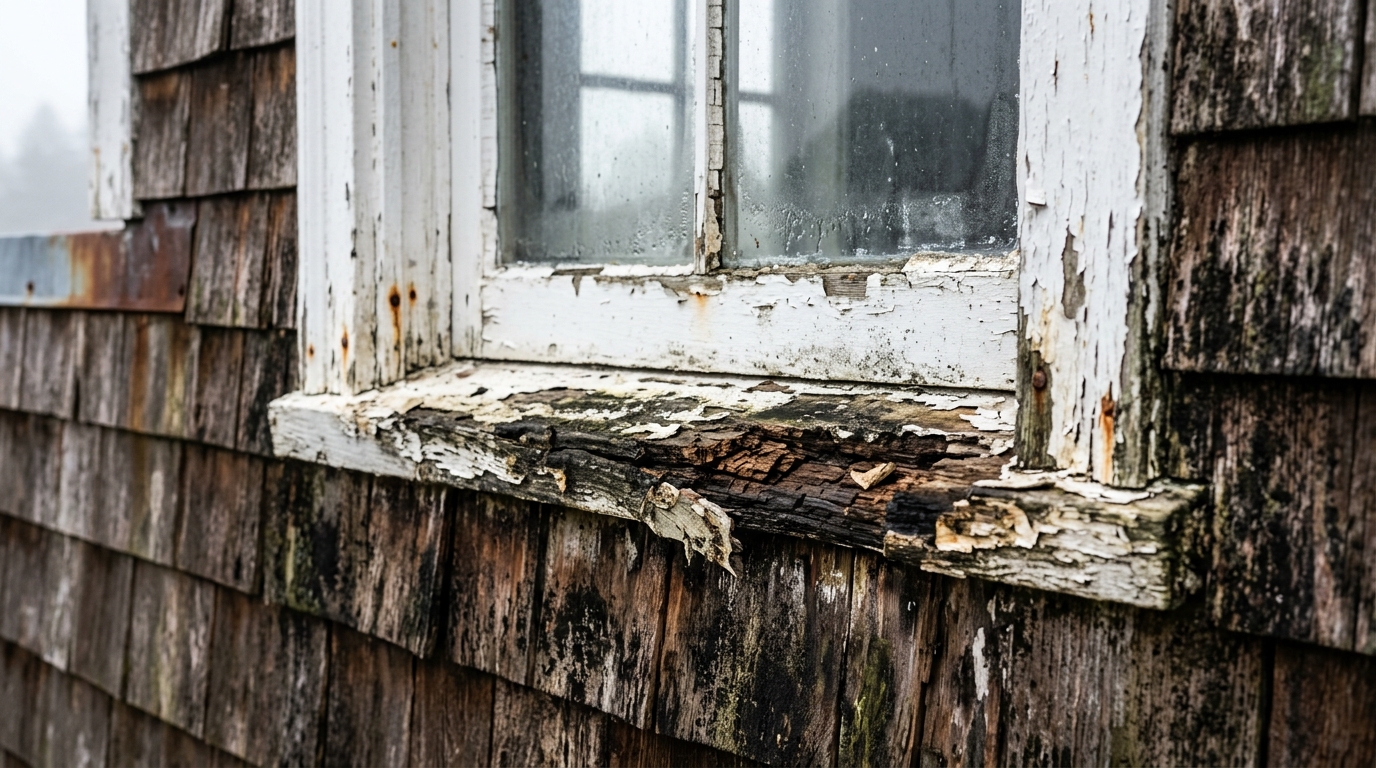
Hygroscopic Salt Deposition & Structural Moisture Retention
Marine fog carries aerosolized sodium chloride (NaCl) and trace sea minerals that settle into porous exterior building substrates (such as exterior timber trim, window sash joints, sill nosings, and siding fasteners). Salt is a powerful hygroscopic compound that lowers the critical relative.
Marine fog carries aerosolized sodium chloride (NaCl) and trace sea minerals that settle into porous exterior building substrates (such as exterior timber trim, window sash joints, sill nosings, and siding fasteners).
Salt is a powerful hygroscopic compound that lowers the critical relative humidity threshold for water absorption to just 75% RH. This physical phenomenon causes coastal window sills and framing members to remain perpetually damp and chemically saturated long after the morning fog burns off.
As water-soluble wood extractives leach away, fungal decay fungi (such as Coniophora puteana and Serpula lacrymans) initiate rapid lignin breakdown, turning structural framing into soft, spongy dry rot.
Window Sill Flashing Failures & Hidden Cavity Mold
Modern coastal architecture frequently suffers from sub-surface flashing failures beneath panoramic ocean-view window assemblies. When wind-driven coastal fog penetrates corner miter joints or failed silicone caulking, moisture drains behind exterior weather-resistive barriers (WRBs) and pools directly onto rough timber sills.
Modern coastal architecture frequently suffers from sub-surface flashing failures beneath panoramic ocean-view window assemblies. When wind-driven coastal fog penetrates corner miter joints or failed silicone caulking, moisture drains behind exterior weather-resistive barriers (WRBs) and pools directly onto rough timber sills.
Because interior air conditioning creates a temperature gradient, trapped moisture cannot dry toward the exterior. Within 30 to 60 days, concealed wall cavities below coastal windows develop extensive Condition 3 black mold contamination that migrates unseen along insulation batting before breaking through interior baseboards.
Non-Destructive Thermal Diagnostics & Boroscope Scoping
Certified coastal environmental inspectors utilize high-resolution FLIR thermal imaging paired with articulating fiber-optic boroscopes to inspect window framing cavities without destructive wall demolition. Infrared scans highlight distinct low-temperature anomalies along window jambs where evaporative cooling occurs. Technicians drill minute 6mm inspection ports.
Certified coastal environmental inspectors utilize high-resolution FLIR thermal imaging paired with articulating fiber-optic boroscopes to inspect window framing cavities without destructive wall demolition. Infrared scans highlight distinct low-temperature anomalies along window jambs where evaporative cooling occurs.
Technicians drill minute 6mm inspection ports through baseboard trim lines, inserting digital boroscopes with LED illumination to inspect wall cavity framing studs, insulation conditions, and fungal colony density behind exterior sheathing.
Marine-Grade Remediation & Vapor Permeability Upgrades
Remediation in coastal marine zones requires specialized antimicrobial treatments resistant to continuous high humidity. Technicians extract contaminated framing members under negative pressure containment and treat surrounding structural timber with concentrated disodium octaborate tetrahydrate (DOT) borate wood preservatives. To prevent future moisture entrapment.
Remediation in coastal marine zones requires specialized antimicrobial treatments resistant to continuous high humidity. Technicians extract contaminated framing members under negative pressure containment and treat surrounding structural timber with concentrated disodium octaborate tetrahydrate (DOT) borate wood preservatives.
To prevent future moisture entrapment, contractors install breathable self-adhering flashing membranes, back-ventilated rainscreen cladding systems with a minimum 3/8-inch air gap, and dedicated whole-home ultra-efficient dehumidifiers configured to hold indoor RH below 45%.