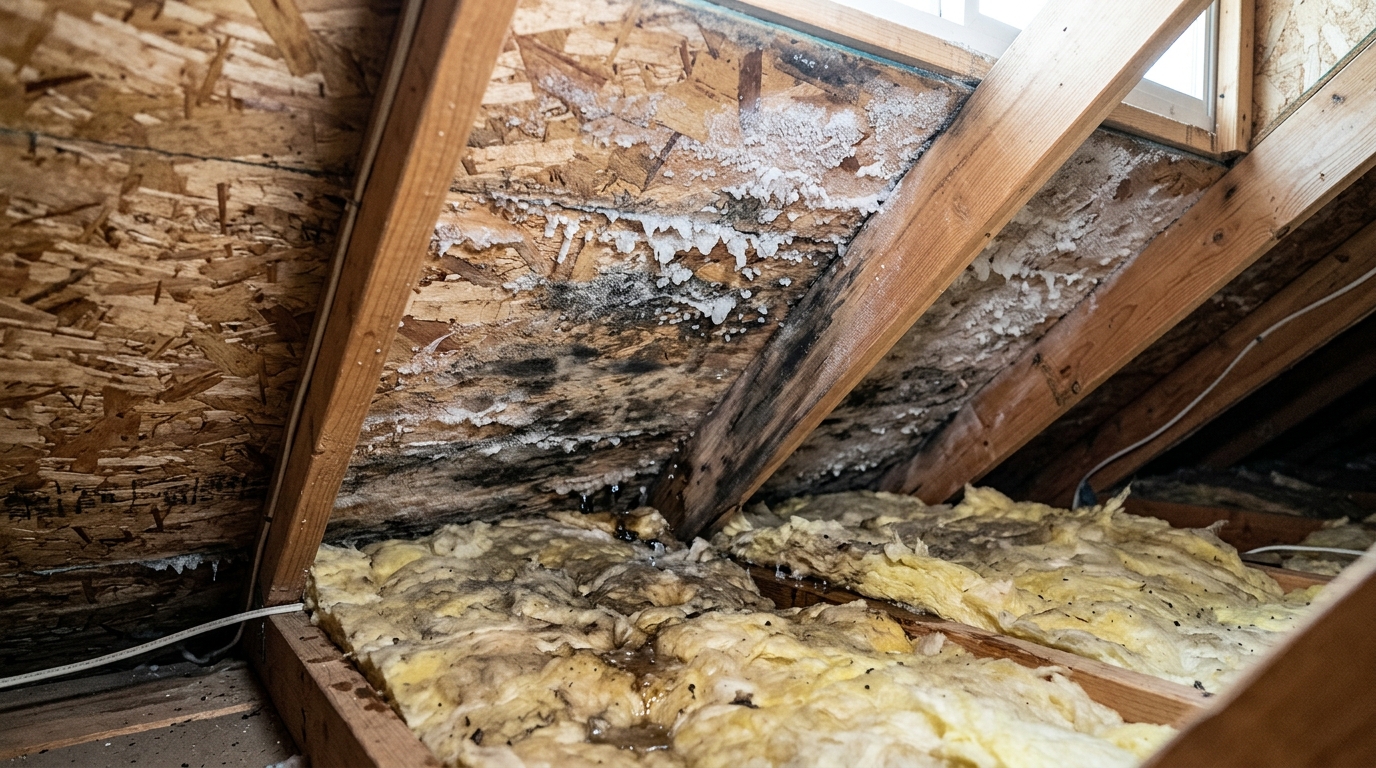
High-Altitude Stack Effect Physics & Thermal Bypass Infiltration
The Stack Effect intensifies at high altitudes (5,000 to 8,000+ feet) due to lower atmospheric pressure and extreme interior-to-exterior temperature differentials. As heated indoor air rises, it generates continuous positive pressure against top-floor ceilings. Unsealed gaps around electrical conduit, bathroom exhaust ducts.
The Stack Effect intensifies at high altitudes (5,000 to 8,000+ feet) due to lower atmospheric pressure and extreme interior-to-exterior temperature differentials. As heated indoor air rises, it generates continuous positive pressure against top-floor ceilings.
Unsealed gaps around electrical conduit, bathroom exhaust ducts, and chimney flues transport up to 35 quarts of water vapor into the attic envelope over a single heating season.
Because freezing roof decking sits at sub-zero temperatures, water vapor bypasses the liquid state, sublimating directly into thick crystalline rime frost.
The Spring Thaw Saturation Crisis & Structural Delamination
When intense Colorado sunshine warms asphalt shingles during March and April thaws, frozen roof decks melt rapidly from the top down. Liquid water drips into blown fiberglass and cellulose insulation, turning ceiling insulation into water-logged sponges that hold moisture against drywall ceilings.
When intense Colorado sunshine warms asphalt shingles during March and April thaws, frozen roof decks melt rapidly from the top down. Liquid water drips into blown fiberglass and cellulose insulation, turning ceiling insulation into water-logged sponges that hold moisture against drywall ceilings for weeks.
Unventilated roof decks experience prolonged timber saturation exceeding 30.0% WME, causing structural OSB resin delamination, wood rot, and airborne mycotoxin proliferation.
Cryogenic CO2 Dry Ice Blasting at -109.3°F
Remediating frost-melted attic roof decking requires cryogenic CO2 dry ice blasting. Certified technicians operate commercial blasting units at 300 PSI utilizing solid carbon dioxide micro-pellets at -109.3°F. Kinetic impact and immediate thermal shock micro-fracture fungal mycelia, sublimating dry ice instantly into gas.
Remediating frost-melted attic roof decking requires cryogenic CO2 dry ice blasting. Certified technicians operate commercial blasting units at 300 PSI utilizing solid carbon dioxide micro-pellets at -109.3°F.
Kinetic impact and immediate thermal shock micro-fracture fungal mycelia, sublimating dry ice instantly into gas without adding liquid moisture to cold wood framing. Technicians execute this protocol inside negative air containment (-5 Pa) with continuous HEPA filtration exhausting outside.
Two-Component Closed-Cell Polyurethane Air Sealing
Permanent prevention of attic frost requires eliminating the root-cause thermal bypasses. Following dry ice fungal extraction and botanical antimicrobial fogging, technicians seal all ceiling electrical penetrations, top plates, and chases with two-component closed-cell polyurethane spray foam rated at R-7 per inch.
Permanent prevention of attic frost requires eliminating the root-cause thermal bypasses. Following dry ice fungal extraction and botanical antimicrobial fogging, technicians seal all ceiling electrical penetrations, top plates, and chases with two-component closed-cell polyurethane spray foam rated at R-7 per inch.
Remediators install continuous baffled ventilation channels from soffit to ridge to ensure an unobstructed 1:150 NFVA airflow ratio.