Thermodynamic Mechanics of Desert Concrete Slab Sweating
Concrete slab sweating (known technically as Surface Moisture Vapor Emission) is governed by Fick’s Law of Diffusion and thermal vapor pressure differentials. When flash floods saturate sub-slab soils, sub-surface vapor pressure reaches 100% saturation beneath the foundation. Meanwhile, interior air conditioning maintains.
Concrete slab sweating (known technically as Surface Moisture Vapor Emission) is governed by Fick’s Law of Diffusion and thermal vapor pressure differentials. When flash floods saturate sub-slab soils, sub-surface vapor pressure reaches 100% saturation beneath the foundation.
Meanwhile, interior air conditioning maintains lower vapor pressure inside living spaces. This thermodynamic gradient forces water vapor upward through concrete capillary networks.
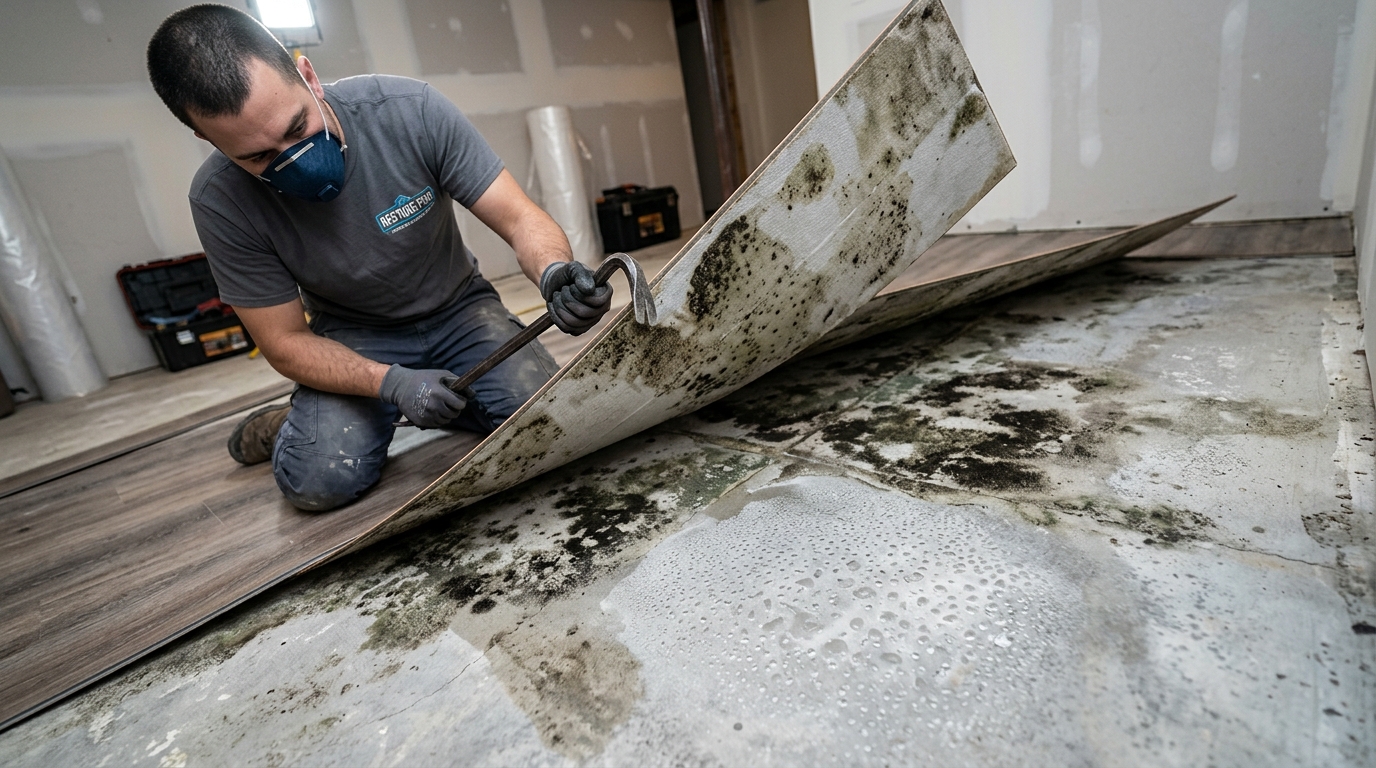
When rising vapor encounters impermeable floor coverings (such as rubber-backed LVP, sheet vinyl, polyurethane adhesives, or epoxy coatings), it condenses into liquid water droplets directly at the bond line.
Floor Covering Delamination & Sub-Floor Mold Blooms
Trapped moisture beneath impermeable desert flooring causes high-alkalinity chemical hydrolysis of flooring adhesives, dissolving mastic glues into foul-smelling white liquid slurry. Alkaline moisture (pH 10.0 to 12.0) degrades vinyl backings and carpet pads, releasing volatile organic compounds (VOCs) and creating optimal micro-environments.
Trapped moisture beneath impermeable desert flooring causes high-alkalinity chemical hydrolysis of flooring adhesives, dissolving mastic glues into foul-smelling white liquid slurry.
Alkaline moisture (pH 10.0 to 12.0) degrades vinyl backings and carpet pads, releasing volatile organic compounds (VOCs) and creating optimal micro-environments for fungal spore germination.
Homeowners frequently observe bubbling laminate seams, cupping wood planks, black discoloration along baseboard joints, and persistent musty odors while surface rooms appear completely dry.
ASTM F2170 & ASTM F1869 Diagnostic Moisture Testing
Certified environmental investigators quantify sub-slab moisture using standardized diagnostic protocols. Technicians install in-situ relative humidity probes directly into core-drilled slab holes according to ASTM F2170 standards, measuring internal slab relative humidity (where readings above 75% indicate active risk). Inspectors also deploy Calcium.
Certified environmental investigators quantify sub-slab moisture using standardized diagnostic protocols. Technicians install in-situ relative humidity probes directly into core-drilled slab holes according to ASTM F2170 standards, measuring internal slab relative humidity (where readings above 75% indicate active risk).
Inspectors also deploy Calcium Chloride dome tests (ASTM F1869) to measure Moisture Vapor Emission Rate (MVER). Readings exceeding 3.0 lbs/1,000 sq. ft./24 hours require mandatory containment, flooring removal, and specialized moisture mitigation.
Slab Remediation & Moisture Vapor Barrier Mitigation
Remediating flash-flood slab sweating requires isolating the affected area under negative air containment (-5 Pa) with continuous HEPA air filtration. Technicians remove contaminated floor coverings, scrape hydrolyzed adhesives, and mechanically grind the concrete surface using diamond-head grinders to open capillary pores.
Remediating flash-flood slab sweating requires isolating the affected area under negative air containment (-5 Pa) with continuous HEPA air filtration. Technicians remove contaminated floor coverings, scrape hydrolyzed adhesives, and mechanically grind the concrete surface using diamond-head grinders to open capillary pores.
Remediators apply EPA-registered botanical antimicrobials followed by industrial desiccant dehumidification until slab RH stabilizes. To prevent future vapor drive, technicians install 100% solids epoxy moisture vapor mitigation barriers rated to withstand up to 25 lbs MVER before new flooring installation.