Pathology & Chemical Hazards of Storm Surge Blackwater
Category 3 storm surge water carries a complex cocktail of biological toxins (such as gram-negative coliform bacteria, endotoxins, fungal mycotoxins, fuel hydrocarbons, and heavy metals) that penetrate porous interior building materials instantaneously. Fibrous insulation batts act as high-capacity sponge reservoirs, trapping hazardous.
Category 3 storm surge water carries a complex cocktail of biological toxins (such as gram-negative coliform bacteria, endotoxins, fungal mycotoxins, fuel hydrocarbons, and heavy metals) that penetrate porous interior building materials instantaneously.
Fibrous insulation batts act as high-capacity sponge reservoirs, trapping hazardous silt and liquid pathogens against wood and steel framing studs. If contaminated insulation remains inside wall cavities, indoor bioaerosol concentrations skyrocket, causing extreme respiratory toxicity, dermatological ulcerations, and systemic inflammation among residential occupants.
Decontamination mandates full extraction and disposal under hazardous waste containment protocols.
Capillary Wicking Dynamics & The 24/48-Inch Flood Cut Standard
Gypsum wallboard exhibits rapid vertical capillary wicking dynamics when submerged in standing storm surge waters. Porous gypsum cores pull liquid moisture upward between 12 to 24 inches above the actual high-water line within hours. Certified remediation technicians establish clean chalk lines exactly.
Gypsum wallboard exhibits rapid vertical capillary wicking dynamics when submerged in standing storm surge waters. Porous gypsum cores pull liquid moisture upward between 12 to 24 inches above the actual high-water line within hours.
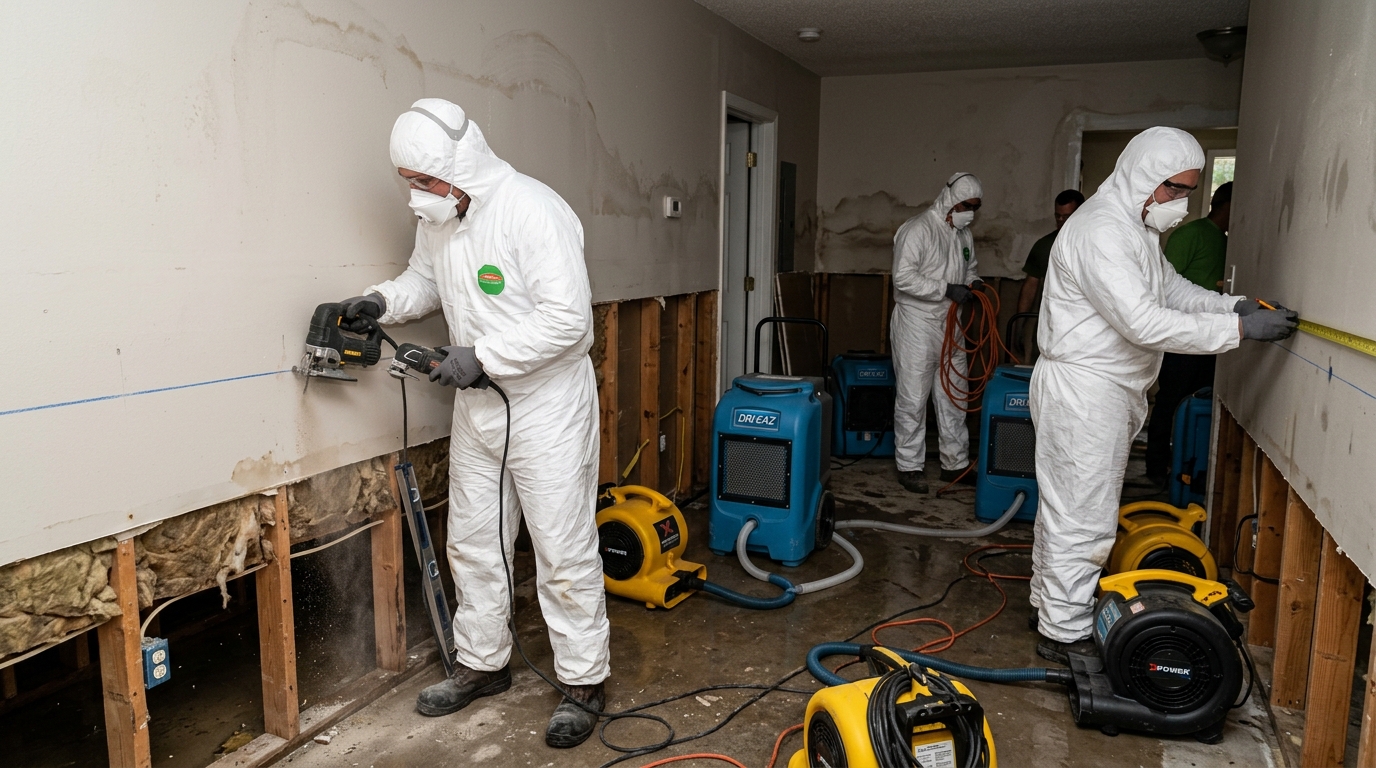
Certified remediation technicians establish clean chalk lines exactly 12 to 24 inches above the highest moisture boundary, executing standard 24-inch, 48-inch, or full-height horizontal flood cuts using oscillating plunge cutters.
This precision geometry exposes wet wall studs to direct airflow, prevents unnecessary structural tear-outs of unaffected upper walls, and allows technicians to extract contaminated cavity insulation down to bare framing.
Antimicrobial Decontamination & Pressure Washing Protocol
Following cavity gutting, exposed structural elements (such as southern yellow pine studs, bottom sole plates, and concrete slab foundations) undergo rigorous mechanical decontamination. Technicians apply EPA-registered broad-spectrum botanical hospital-grade disinfectants containing thymol or quaternary ammonium compounds. Remediators scrub framing assemblies with wire.
Following cavity gutting, exposed structural elements (such as southern yellow pine studs, bottom sole plates, and concrete slab foundations) undergo rigorous mechanical decontamination. Technicians apply EPA-registered broad-spectrum botanical hospital-grade disinfectants containing thymol or quaternary ammonium compounds.
Remediators scrub framing assemblies with wire brushes or low-pressure hot-water extraction units to dislodge stubborn storm silt and fungal root matrices. Technicians repeat antimicrobial applications until surface ATP (adenosine triphosphate) bioluminescence testing registers below 10 RLU (Relative Light Units).
High-Volume Structural Drying & Moisture Target Thresholds
Structural drying in tropical hurricane zones (including Miami, Fort Myers, Cape Coral, Tampa, and Sarasota) requires heavy commercial equipment due to saturated subfloors and elevated outdoor humidity. Restoration commanders establish negative-pressure drying chambers utilizing Low Grain Refrigerant (LGR) dehumidifiers and high-velocity axial.
Structural drying in tropical hurricane zones (including , , , , and ) requires heavy commercial equipment due to saturated subfloors and elevated outdoor humidity.
Restoration commanders establish negative-pressure drying chambers utilizing Low Grain Refrigerant (LGR) dehumidifiers and high-velocity axial air movers generating over 3,000 CFM across framing bays. Technicians record daily temperature, relative humidity, and grains per pound (GPP) readings.
Deconstruction containment remains sealed until pin-probe moisture readings in wood framing stabilize below 14.0% WME and concrete slabs test below 75% internal relative humidity under ASTM F2170 in-situ probe standards.