Pathology & Biohazards of Jersey Shore Category 3 Storm Surges
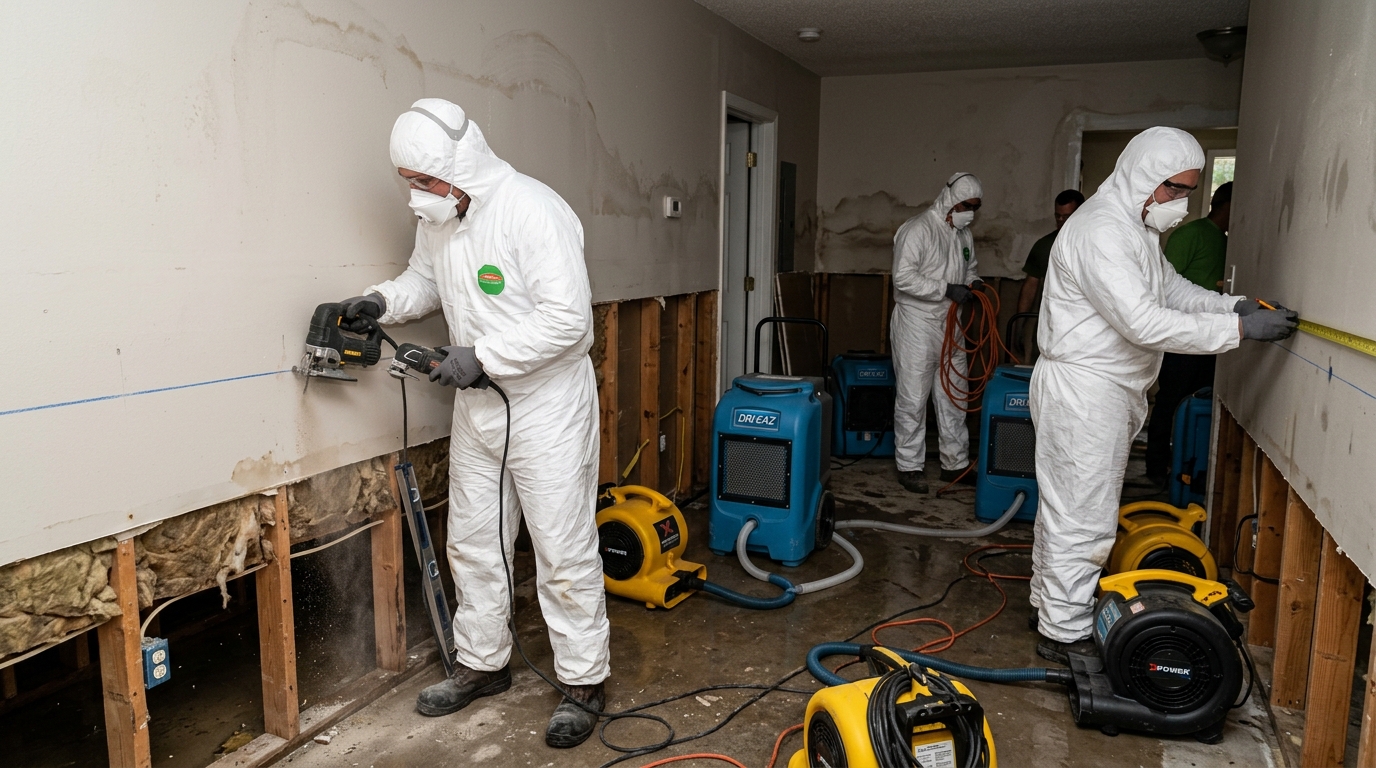
Nor'easter storm surges force saline floodwaters into coastal crawl spaces and ground-floor residential living areas. Category 3 floodwaters contain millions of bacterial coliforms, endotoxins, and fungal spores. Saturated insulation batts act as high-capacity sponge reservoirs, trapping hazardous silt and liquid pathogens against.
Nor'easter storm surges force saline floodwaters into coastal crawl spaces and ground-floor residential living areas. Category 3 floodwaters contain millions of bacterial coliforms, endotoxins, and fungal spores.
Saturated insulation batts act as high-capacity sponge reservoirs, trapping hazardous silt and liquid pathogens against wood framing studs. Leaving contaminated insulation inside wall cavities results in massive bioaerosol spikes, causing severe respiratory distress and fungal cross-contamination throughout the entire home.
Capillary Wicking Dynamics & The 48-Inch Flood Cut Standard
Porous gypsum wallboard exhibits aggressive capillary action, pulling storm surge water upward between 12 and 24 inches above the visible flood line within hours. Certified remediation technicians establish clean chalk lines exactly 12 to 24 inches above the highest moisture reading, executing.
Porous gypsum wallboard exhibits aggressive capillary action, pulling storm surge water upward between 12 and 24 inches above the visible flood line within hours.
Certified remediation technicians establish clean chalk lines exactly 12 to 24 inches above the highest moisture reading, executing standardized 24-inch or 48-inch horizontal flood cuts.
This precision deconstruction exposes structural framing bays to direct high-velocity airflow, allows complete removal of contaminated insulation, and simplifies post-remediation drywall installation.
New Jersey DCA Rehabilitation Subcode & Code Compliance
Reconstructing coastal residential properties in New Jersey requires strict compliance with the NJ DCA Rehabilitation Subcode. Remediation contractors must verify that structural wall studs, bottom plates, and subfloor assemblies are decontaminated with EPA-registered botanical antimicrobials and structurally dried below 14.
Reconstructing coastal residential properties in New Jersey requires strict compliance with the NJ DCA Rehabilitation Subcode.
Remediation contractors must verify that structural wall studs, bottom plates, and subfloor assemblies are decontaminated with EPA-registered botanical antimicrobials and structurally dried below 14.0% WME before local municipal building inspectors in Ocean and Monmouth Counties will issue reconstruction building permits.
Desiccant Dehumidification & PRV Air Testing Clearance
Extracting coastal storm surge moisture from concrete slabs and saturated wood timber requires heavy commercial Low Grain Refrigerant (LGR) and desiccant dehumidifiers generating airflow exceeding 2,500 CFM. Technicians operate negative air scrubbers (99.97% HEPA filtration) continuously. Following structural drying, an independent environmental.
Extracting coastal storm surge moisture from concrete slabs and saturated wood timber requires heavy commercial Low Grain Refrigerant (LGR) and desiccant dehumidifiers generating airflow exceeding 2,500 CFM. Technicians operate negative air scrubbers (99.97% HEPA filtration) continuously.
Following structural drying, an independent environmental consultant collects PRV spore trap cassettes to certify Condition 1 normal fungal ecology before reconstruction commences.