Physical Mechanics of Desert Monsoon Vapor Drive
Vapor drive forces moisture through permeable exterior building envelopes whenever outdoor absolute humidity exceeds indoor air conditioning conditions. Desert construction relies heavily on exterior stucco and synthetic EIFS claddings (such as direct-applied polymer coatings, Portland cement plaster, and concrete masonry units) that.
Vapor drive forces moisture through permeable exterior building envelopes whenever outdoor absolute humidity exceeds indoor air conditioning conditions.
Desert construction relies heavily on exterior stucco and synthetic EIFS claddings (such as direct-applied polymer coatings, Portland cement plaster, and concrete masonry units) that absorb sudden monsoon downpours.
When intense solar radiation follows rainstorms, trapped envelope moisture vaporizes at temperatures exceeding 130°F, creating extreme vapor pressure differentials exceeding 1.20 inches of mercury (inHg). This inward vapor drive pushes moisture molecules directly into unconditioned wall cavities unless sealed with Class II vapor retarders.
As hot humid air contacts interior gypsum cooled by central air conditioning, invisible micro-condensation forms on the backside of drywall assemblies within 12 hours.
The 48-Hour Biological Colonization Timeline
Fungal germination follows strict biophysical laws governed by water activity (aw) thresholds across susceptible organic materials (such as cellulose-faced drywall, paper tape joints, organic paste adhesives, and carpet backings). At water activity levels above 0.85 aw, xerophilic molds (such as Aspergillus penicillioides.
Fungal germination follows strict biophysical laws governed by water activity (aw) thresholds across susceptible organic materials (such as cellulose-faced drywall, paper tape joints, organic paste adhesives, and carpet backings).
At water activity levels above 0.85 aw, xerophilic molds (such as Aspergillus penicillioides and Wallemia sebi) germinate within 18 hours. By hour 36, tertiary hydrophilic molds (such as Stachybotrys chartarum and Chaetomium globosum) establish dense mycotoxin-releasing hyphal colonies if structural drying remains delayed.
When relative humidity exceeds 70% continuously for 48 hours, spore concentration counts inside wall cavities escalate from background levels (<200 spores/m³) to hazardous levels exceeding 45,000 spores/m³.
FLIR Thermal Imaging & Moisture Meter Diagnostic Thresholds
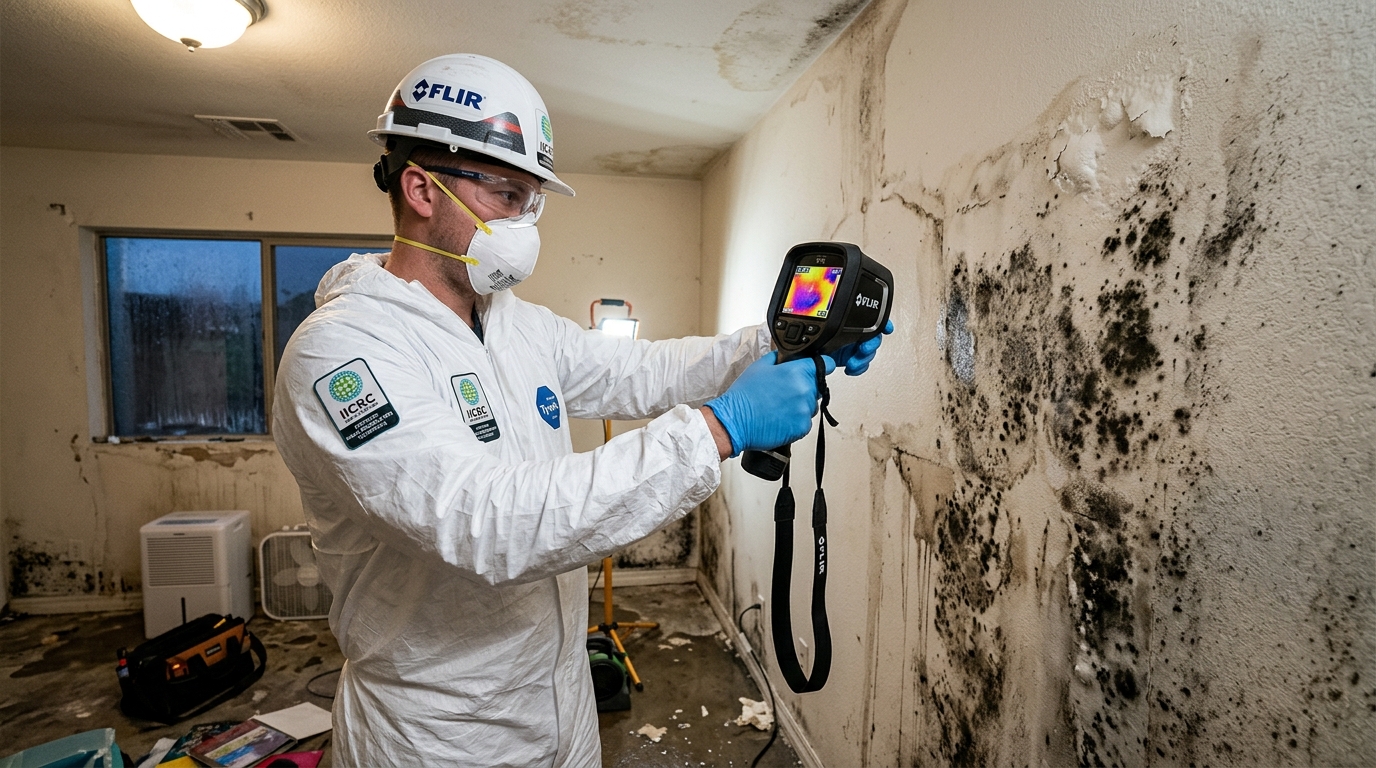
Certified environmental diagnostic specialists deploy calibrated FLIR E8-XT infrared cameras and Tramex non-invasive capacitance meters to pinpoint monsoon moisture traps behind pristine paint surfaces. Thermal imaging reveals subtle evaporative cooling signatures ranging from 2.5°F to 6.0°F below ambient wall temperatures.
Certified environmental diagnostic specialists deploy calibrated FLIR E8-XT infrared cameras and Tramex non-invasive capacitance meters to pinpoint monsoon moisture traps behind pristine paint surfaces. Thermal imaging reveals subtle evaporative cooling signatures ranging from 2.5°F to 6.0°F below ambient wall temperatures.
Technicians verify moisture saturation levels using pin-type resistance probes across structural studs (such as Douglas fir wall plates, ceiling joists, and floor sills).
Remediators categorize drywall moisture into three distinct operational states: Condition 1 Normal (<12.0% WME), Condition 2 Elevated (12.1% to 16.9% WME), and Condition 3 Saturated (>17.0% WME requiring controlled EPA containment).
Commercial Desiccant Dehumidification Protocols
Standard residential air conditioners cannot extract sudden monsoon humidity surges because oversized cooling units short-cycle before completing adequate latent heat moisture removal. Certified restoration teams erect negative air containment barriers under -5 Pascals of pressure and deploy commercial Low Grain Refrigerant (LGR).
Standard residential air conditioners cannot extract sudden monsoon humidity surges because oversized cooling units short-cycle before completing adequate latent heat moisture removal.
Certified restoration teams erect negative air containment barriers under -5 Pascals of pressure and deploy commercial Low Grain Refrigerant (LGR) and desiccant dehumidifiers producing airflow exceeding 1,200 CFM.
Technicians drive indoor grains per pound (GPP) from ambient levels above 110 GPP down to dry standard targets below 40 GPP within 24 hours.
Air scrubbers utilizing true HEPA filtration (99.97% retention at 0.3 microns) operate at 8 air changes per hour (ACH) to capture aerosolized mycotoxins during targeted drywall extraction.