The Physiology of the Nocturnal Amygdala Suffocation Alarm
The amygdala is densely populated with acid-sensing ion channels (ASIC1a) and cytokine receptors that monitor cerebral pH and oxygen saturation. During healthy sleep, respiratory rate and tidal volume naturally decrease. However, in bedrooms contaminated with volatile organic compounds (MVOCs) and trichothecenes, mycotoxins.
The amygdala is densely populated with acid-sensing ion channels (ASIC1a) and cytokine receptors that monitor cerebral pH and oxygen saturation. During healthy sleep, respiratory rate and tidal volume naturally decrease.
However, in bedrooms contaminated with volatile organic compounds (MVOCs) and trichothecenes, mycotoxins induce mild mucosal airway swelling and sub-clinical alveolar hypoventilation. When mycotoxin-induced neuro-inflammation swells the amygdala, its baseline activation threshold drops dramatically.
A minor nocturnal dip in oxygen saturation is misinterpreted as life-threatening asphyxiation, firing the central nucleus of the amygdala and triggering the locus coeruleus to flood the bloodstream with catecholamines.
Common Concealed Bedroom Mold Reservoirs
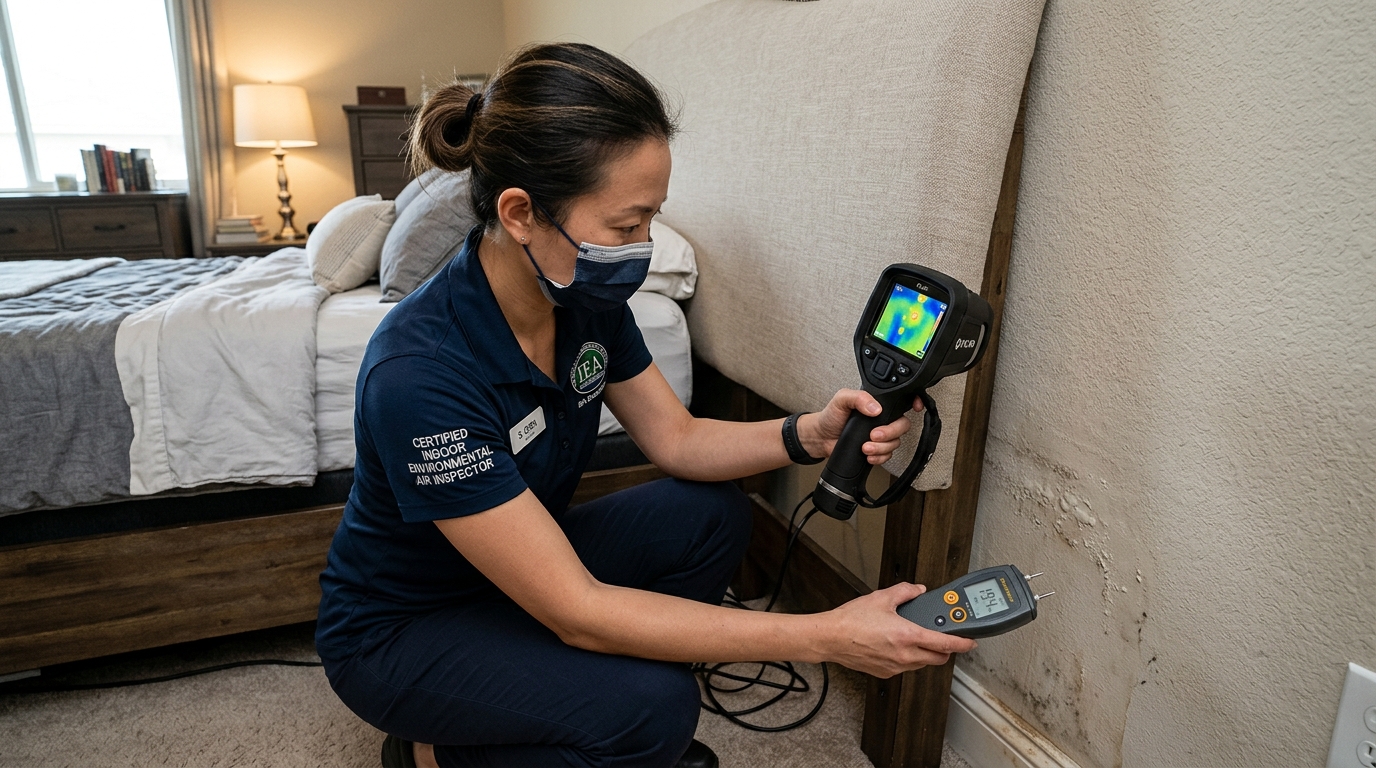
Bedroom fungal colonization is frequently invisible upon casual visual inspection. Certified environmental investigators identify typical hidden reservoirs: (1) condensation moisture behind furniture and headboards placed tightly against cold exterior drywall, (2) dust-mite and fungal mycelial growth inside natural latex or memory foam.
Bedroom fungal colonization is frequently invisible upon casual visual inspection.
Certified environmental investigators identify typical hidden reservoirs: (1) condensation moisture behind furniture and headboards placed tightly against cold exterior drywall, (2) dust-mite and fungal mycelial growth inside natural latex or memory foam mattresses that absorb body sweat, (3) leaking window sill framing beneath closed curtains, and (4) uninsulated AC flexible ductwork sweating above bedroom ceiling drywall.
Diagnostic Evaluation: NeuroQuant Limbic Volume & Catecholamine Surges
Patients misdiagnosed with primary panic disorder or generalized anxiety can establish biological etiology through objective medical testing: volumetric NeuroQuant MRI imaging reveals acute hyper-intensity and enlargement of the limbic system and amygdala. Nocturnal 24-hour urinary catecholamine panels capture massive spikes in adrenaline.
Patients misdiagnosed with primary panic disorder or generalized anxiety can establish biological etiology through objective medical testing: volumetric NeuroQuant MRI imaging reveals acute hyper-intensity and enlargement of the limbic system and amygdala.
Nocturnal 24-hour urinary catecholamine panels capture massive spikes in adrenaline and noradrenaline metabolites corresponding to nighttime waking events, confirming a physiological rather than psychological origin.
Bedroom Environmental Decontamination & HVAC Containment
Eliminating nocturnal panic attacks requires immediate environmental source control: (1) establishing negative-air containment (-5 Pa) during bedroom remediation, (2) stripping water-stained drywall and replacing contaminated carpeting with non-porous hardwood or tile, (3) deep-cleaning HVAC supply boots and plenum boxes with botanical antimicrobials.
Eliminating nocturnal panic attacks requires immediate environmental source control: (1) establishing negative-air containment (-5 Pa) during bedroom remediation, (2) stripping water-stained drywall and replacing contaminated carpeting with non-porous hardwood or tile, (3) deep-cleaning HVAC supply boots and plenum boxes with botanical antimicrobials,
and (4) installing medical-grade HEPA/carbon air purifiers delivering at least 5 air changes per hour (ACH) to eliminate ultrafine fungal bioaerosols.