Physical Dynamics of North Jersey Fieldstone Hydrostatic Seepage
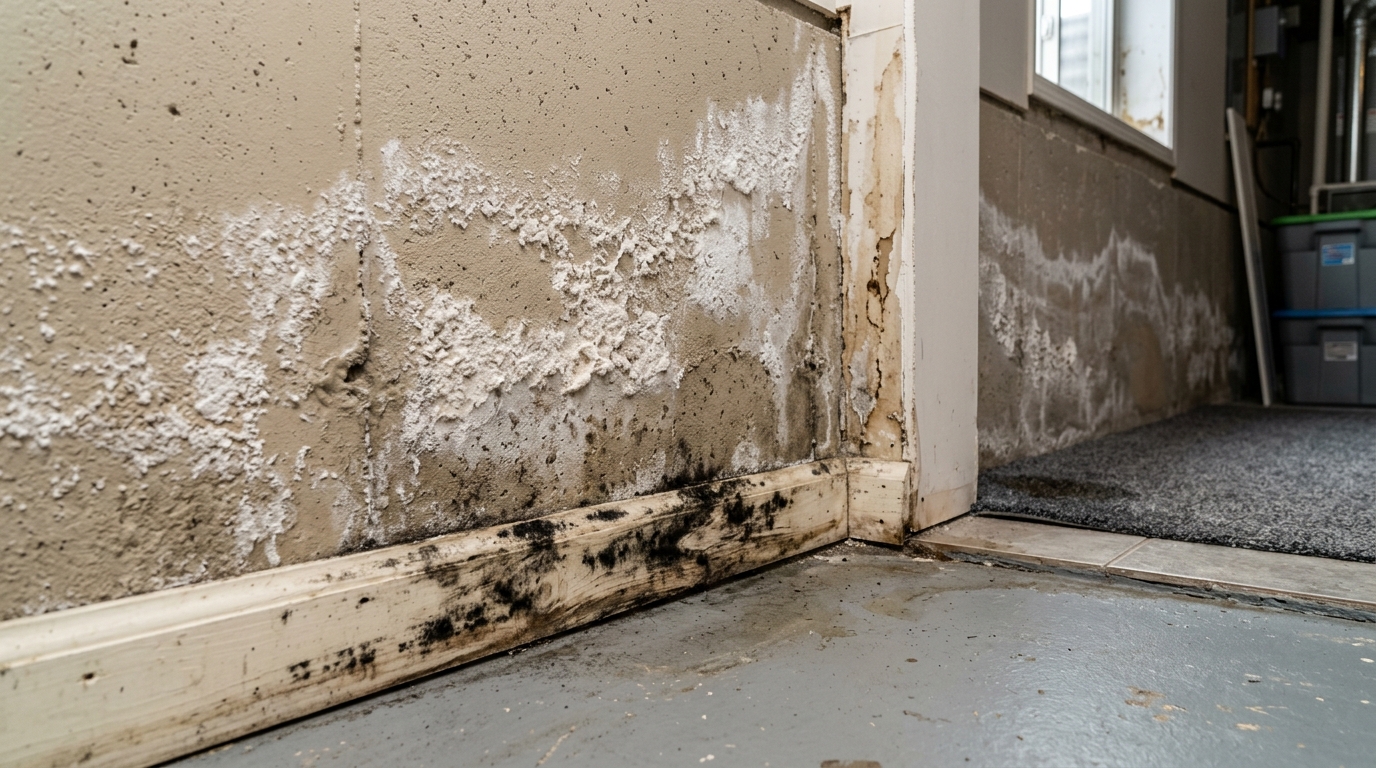
Historic fieldstone foundations consist of irregular quarry stones bound by lime-sand mortar. Unlike modern poured concrete walls with exterior damp-proof membranes, historic stone foundations are permeable masonry systems. When saturated clay soils surrounding the foundation reach capacity, hydrostatic force pushes groundwater through.
Historic fieldstone foundations consist of irregular quarry stones bound by lime-sand mortar. Unlike modern poured concrete walls with exterior damp-proof membranes, historic stone foundations are permeable masonry systems. When saturated clay soils surrounding the foundation reach capacity, hydrostatic force pushes groundwater through mortar voids.
As water evaporates into basement air, it leaves behind white mineral salt crystals (efflorescence), proving active subterranean water intrusion.
The Finished Basement Mold Incubator Trap
Modern finished basement renovations in older North Jersey homes often create severe hidden fungal incubators. When contractors install standard fiberglass insulation and gypsum drywall directly against historic stone walls without capillary breaks, trapped moisture cannot evaporate. The dark, unventilated cavity between the.
Modern finished basement renovations in older North Jersey homes often create severe hidden fungal incubators. When contractors install standard fiberglass insulation and gypsum drywall directly against historic stone walls without capillary breaks, trapped moisture cannot evaporate.
The dark, unventilated cavity between the stone wall and drywall becomes an ideal breeding ground for toxic black mold, which rots bottom framing plates and releases musty MVOC gases into upper living areas.
Non-Destructive Fieldstone Remediation & Lime Repointing
Remediating mold on historic stone foundations requires non-destructive techniques to preserve structural integrity. Certified technicians erect negative-air containment (-5 Pa) and use HEPA-filtered scraping to remove fungal mycelia. Remediators repoint compromised mortar joints using breathable, non-hydraulic lime mortar matches (avoiding modern Portland.
Remediating mold on historic stone foundations requires non-destructive techniques to preserve structural integrity. Certified technicians erect negative-air containment (-5 Pa) and use HEPA-filtered scraping to remove fungal mycelia.
Remediators repoint compromised mortar joints using breathable, non-hydraulic lime mortar matches (avoiding modern Portland cement which traps moisture and causes stone spalling). Technicians apply breathable silicate sealers to block liquid water penetration.
Internal Perimeter Drain Tile & Dual Cast-Iron Sump Upgrades
Permanent basement flood protection requires relieving subterranean hydrostatic pressure. Waterproofing specialists install internal sub-floor perforated drain tile weeping grids embedded in washed crushed stone along the foundation perimeter. Drainage channels direct groundwater to a heavy-duty sealed sump basin equipped with dual cast-iron.
Permanent basement flood protection requires relieving subterranean hydrostatic pressure. Waterproofing specialists install internal sub-floor perforated drain tile weeping grids embedded in washed crushed stone along the foundation perimeter.
Drainage channels direct groundwater to a heavy-duty sealed sump basin equipped with dual cast-iron 1/2 HP pumps and an auxiliary battery backup system capable of pumping 3,000 gallons per hour during power outages.