Phase 1: Emergency Pressurized Water Extraction & Containment
The first 6 hours following a pipe burst determine whether expensive hardwood floors and plaster assemblies can be salvaged. Emergency response units deploy commercial truck-mounted extraction units delivering high vacuum lift exceeding 14 inches of mercury (inHg). Technicians extract standing liquid water.
The first 6 hours following a pipe burst determine whether expensive hardwood floors and plaster assemblies can be salvaged. Emergency response units deploy commercial truck-mounted extraction units delivering high vacuum lift exceeding 14 inches of mercury (inHg).
Technicians extract standing liquid water from subfloors, carpets, and concrete slabs, removing up to 90% of free unbonded moisture before it penetrates structural timber joist pockets.
Negative-Pressure Injectidry Vacuum Mat Technology for Hardwood
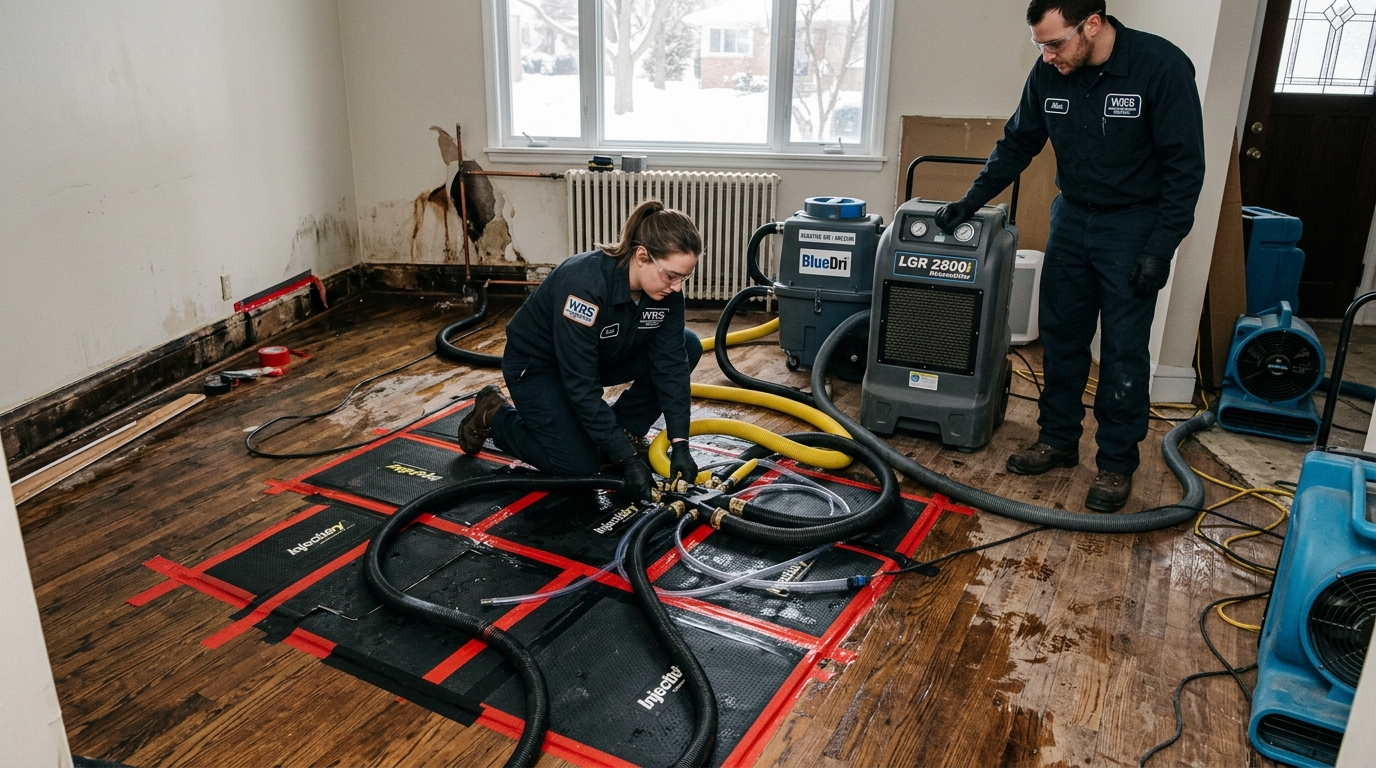
Traditional air movers cannot extract water trapped beneath swollen solid oak and maple plank flooring. Certified restoration technicians install specialized negative-pressure injectidry vacuum mat grids directly over wet hardwood seams. High-powered vacuum units create a continuous hermetic seal, pulling trapped capillary moisture.
Traditional air movers cannot extract water trapped beneath swollen solid oak and maple plank flooring. Certified restoration technicians install specialized negative-pressure injectidry vacuum mat grids directly over wet hardwood seams.
High-powered vacuum units create a continuous hermetic seal, pulling trapped capillary moisture upward through hardwood plank joints without causing cupping, crowning, or board buckling, saving homeowners thousands in replacement costs.
LGR Dehumidification & Psychrometric Drying Tracking
Achieving structural dry standard targets in Western Pennsylvania winter temperatures requires commercial Low Grain Refrigerant (LGR) dehumidifiers capable of operating efficiently in low ambient vapor pressures. Technicians record psychrometric drying logs tracking ambient temperature, relative humidity, and grains per pound (GPP) differentials.
Achieving structural dry standard targets in Western Pennsylvania winter temperatures requires commercial Low Grain Refrigerant (LGR) dehumidifiers capable of operating efficiently in low ambient vapor pressures. Technicians record psychrometric drying logs tracking ambient temperature, relative humidity, and grains per pound (GPP) differentials.
Drying equipment runs continuously until structural framing moisture content tests below 14.0% WME.
Xactimate Insurance Claim Optimization & Itemization
Navigating Pennsylvania homeowners insurance property claims requires detailed itemized documentation using Xactimate industry software. Restoration project managers record comprehensive FLIR thermal imaging scans, pin-probe moisture maps, and daily equipment run-time logs. Invoices are categorized under standardized line-item codes (such as WTR and.
Navigating Pennsylvania homeowners insurance property claims requires detailed itemized documentation using Xactimate industry software. Restoration project managers record comprehensive FLIR thermal imaging scans, pin-probe moisture maps, and daily equipment run-time logs.
Invoices are categorized under standardized line-item codes (such as WTR and HMR), ensuring insurance adjusters approve full compensation for emergency extraction, specialized drying mats, and antimicrobial sanitization.