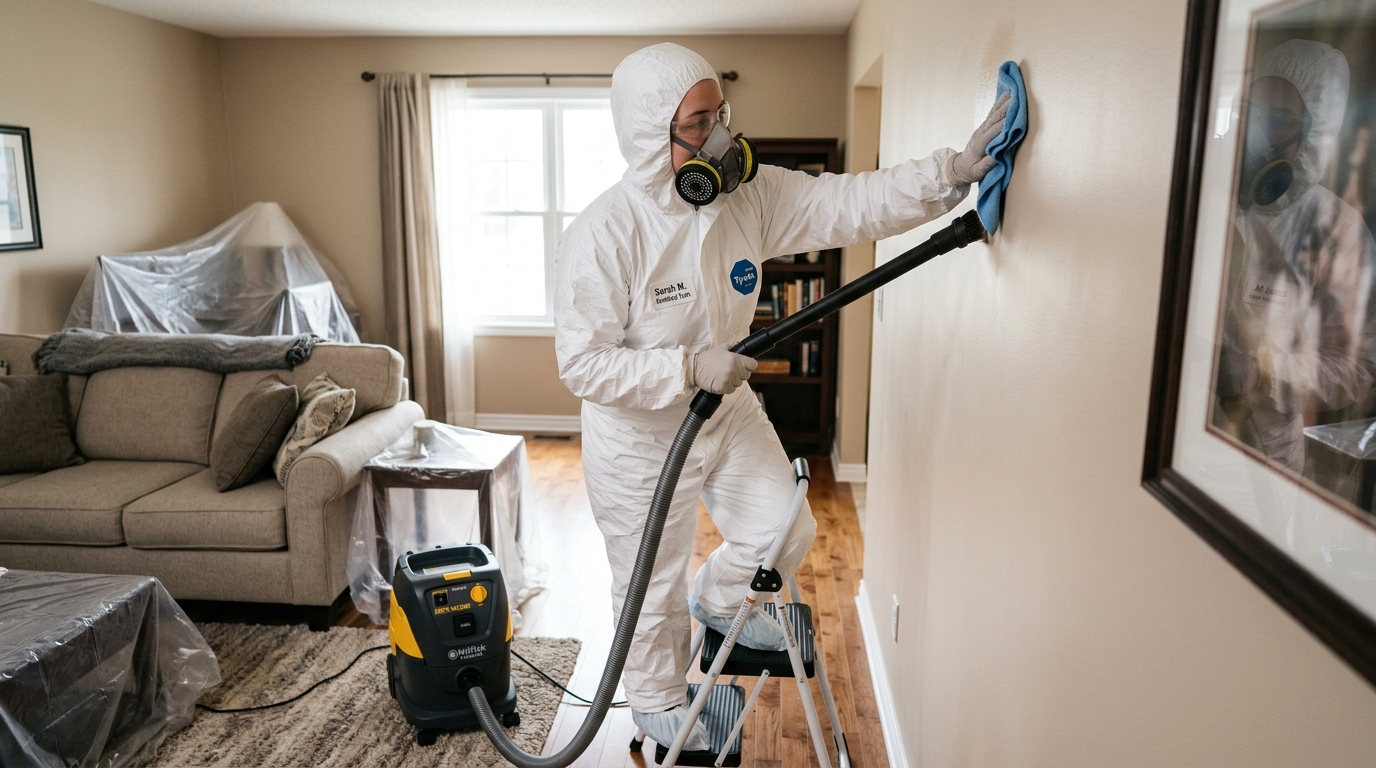
Why Standard Spore Trap Clearance Fails Medically Sensitive Patients
Standard optical spore trap air cassettes (such as Air-O-Cell) only capture intact fungal spores larger than 2.0 microns. However, for every single intact mold spore in a contaminated environment, there are approximately 300 to 500 sub-micron hyphal fragments and aerosolized mycotoxin molecules.
Standard optical spore trap air cassettes (such as Air-O-Cell) only capture intact fungal spores larger than 2.0 microns.
However, for every single intact mold spore in a contaminated environment, there are approximately 300 to 500 sub-micron hyphal fragments and aerosolized mycotoxin molecules floating in the air.
These ultrafine nanometer particles easily bypass upper airway filtration, penetrating deep into the pulmonary alveoli and passing directly into the bloodstream.
If a remediation firm simply tears out drywall and packs up their air scrubbers, billions of ultrafine biotoxin particles remain settled across ceiling fans, walls, ducts, and furnishings.
The 4-Stage Whole-House Small-Particle Micro-Cleaning Protocol
Executing true environmental detoxification for CIRS households follows a strict sequential discipline: (1) Operate HEPA air scrubbers (99.97% efficiency at 0.3 microns) continuously throughout all living zones for at least 72 hours, under certified ANSI/IICRC S520 environmental engineering standards and forensic structural.
Executing true environmental detoxification for CIRS households follows a strict sequential discipline: (1) Operate HEPA air scrubbers (99.97% efficiency at 0.3 microns) continuously throughout all living zones for at least 72 hours,
delivering a minimum of 6 to 8 Air Changes per Hour (ACH). (2) Vacuum 100% of all vertical and horizontal surfaces (ceilings, walls, light fixtures, crown molding, door headers, baseboards,
and floors) using commercial HEPA vacuums fitted with brush agitation attachments. (3) Hand-wipe all hard surfaces using specialized split-microfiber cloths dampened with pure botanical surfactant solutions (folding cloths into 8 clean quadrants to avoid cross-contamination). (4) High-vacuum duct cleaning under negative air paired with evaporator coil wash.
Handling Porous Contents, Furniture & Personal Belongings
CIRS patients must adhere to strict content salvageability rules: Non-porous items (glass, metal, sealed solid wood, hard plastics) can be 100% detoxified through HEPA vacuuming and microfiber damp wiping. Semi-porous items (leather, finished wood furniture) require specialized leather cleaning and HEPA extraction.
CIRS patients must adhere to strict content salvageability rules: Non-porous items (glass, metal, sealed solid wood, hard plastics) can be 100% detoxified through HEPA vacuuming and microfiber damp wiping. Semi-porous items (leather, finished wood furniture) require specialized leather cleaning and HEPA extraction.
Highly porous items (mattresses, upholstered sofas, plush toys, unsealed pillows, and dense cardboard boxes) that were exposed to high concentrations of or cannot be reliably decontaminated and must be discarded to prevent continuous secondary bio-offgassing.
Final Environmental Clearance: DNA HERTSMI-2 Verification
Before a CIRS or MCAS patient returns home, an independent environmental consultant collects composite dust samples across multiple living zones for analysis via quantitative Polymerase Chain Reaction (qPCR). under certified ANSI/IICRC S520 environmental engineering standards and forensic structural moisture remediation guidelines..
Before a CIRS or MCAS patient returns home, an independent environmental consultant collects composite dust samples across multiple living zones for analysis via quantitative Polymerase Chain Reaction (qPCR).
The lab analyzes concentrations of the five most dangerous fungal species: , , , , and .
Safe return requires an aggregate HERTSMI-2 score of (scores between 11–15 indicate borderline risk, and scores >15 guarantee clinical relapse).