Thermodynamics of Coastal Marine Layer Moisture Absorption
Coastal marine inversions force saturated ocean air into unsealed residential crawl spaces and exterior building envelopes throughout Southern California coastal cities (such as Santa Monica, Newport Beach, Huntington Beach, Carlsbad, and La Jolla). Fine sea spray deposits microscopic sodium chloride (NaCl) crystals.
Coastal marine inversions force saturated ocean air into unsealed residential crawl spaces and exterior building envelopes throughout Southern California coastal cities (such as Santa Monica, Newport Beach, Huntington Beach, Carlsbad, and La Jolla).
Fine sea spray deposits microscopic sodium chloride (NaCl) crystals onto timber framing members. Because salt lowers the critical relative humidity threshold for fungal moisture absorption to 75% RH, coastal subfloors remain perpetually damp even during warm, sunny afternoons.
This continuous moisture retention degrades wood cell structures, driving subfloor timber moisture above 22.0% WME and causing chronic wood decay fungi (Coniophora puteana) and black Cladosporium blooms.
Wildfire Soot Nutrient Traps & Attic Fire-Water Saturation
Residential properties in the wildland-urban interface (such as Malibu, Calabasas, Pasadena, Laguna Beach, and Rancho Bernardo) experience severe secondary microbial disasters following wildfire extinguishment. Emergency fire crews discharge between 2,000 and 6,000 gallons of suppression water to protect structural roofs and eaves.
Residential properties in the wildland-urban interface (such as Malibu, Calabasas, Pasadena, Laguna Beach, and Rancho Bernardo) experience severe secondary microbial disasters following wildfire extinguishment. Emergency fire crews discharge between 2,000 and 6,000 gallons of suppression water to protect structural roofs and eaves.
Charred timber surfaces exhibit increased microscopic porosity, allowing water to penetrate deep into structural roof rafters. Fine carbon soot particles act as highly porous nutrient beds that bind moisture tightly against charred wood framing, accelerating fungal spore germination in ambient attic heat.
Cryogenic Dry Ice Blasting for Char & Mold Remediation
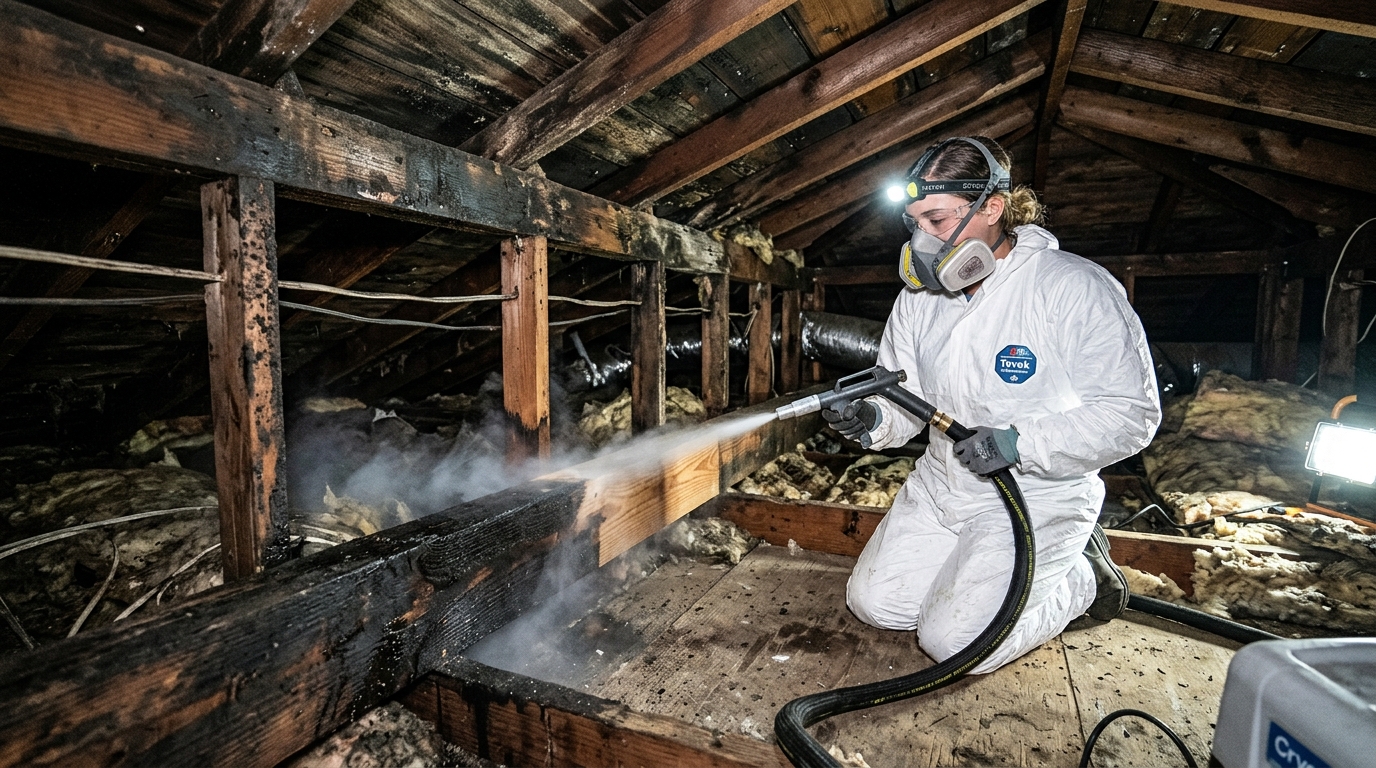
Traditional chemical washing and retail encapsulants fail on fire-damaged and coastal moldy timber because fungal hyphae penetrate up to 4.0 millimeters into open wood grain. Certified restoration specialists deploy heavy-duty cryogenic dry ice blasting systems operating at 300 PSI and utilizing solid.
Traditional chemical washing and retail encapsulants fail on fire-damaged and coastal moldy timber because fungal hyphae penetrate up to 4.0 millimeters into open wood grain.
Certified restoration specialists deploy heavy-duty cryogenic dry ice blasting systems operating at 300 PSI and utilizing solid CO2 micro-pellets at -109.3°F.
Upon kinetic impact, the dry ice pellets instantly sublimate into gas, expanding 800 times in volume to shear charred wood layers, soot residues, and fungal mycelia off structural rafters without generating secondary liquid waste.
Complete 20-Mil Crawl Space Encapsulation Standards
To permanently protect coastal Southern California homes against continuous marine layer fog, contractors install continuous crawl space encapsulation systems. Technicians line 100% of the earthen ground with reinforced 20-mil virgin polyethylene vapor barriers, sealed 6 inches up concrete foundation stem walls with.
To permanently protect coastal Southern California homes against continuous marine layer fog, contractors install continuous crawl space encapsulation systems.
Technicians line 100% of the earthen ground with reinforced 20-mil virgin polyethylene vapor barriers, sealed 6 inches up concrete foundation stem walls with commercial butyl adhesives.
Technicians install dedicated commercial Low Grain Refrigerant (LGR) dehumidifiers configured to maintain crawl space relative humidity strictly below 50% year-round, ensuring framing moisture remains permanently below 13.0% WME.