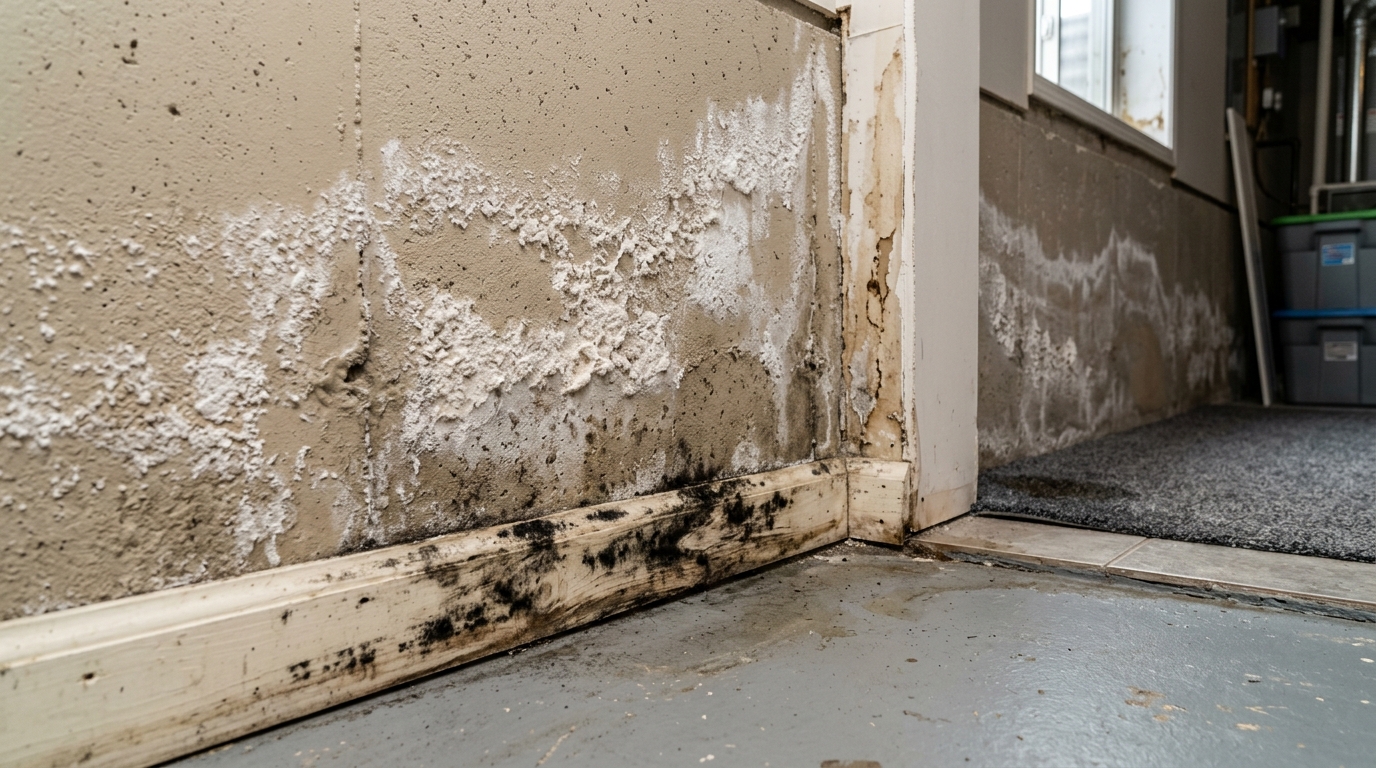
Hydrostatic Pressure Dynamics & Foundation Capillary Action
Hydrostatic pressure exerts continuous lateral and upward force against subterranean basement structures. Concrete is inherently porous, containing millions of microscopic capillary pores that pull liquid groundwater inward through capillary wicking. When exterior soil saturation reaches capacity, hydrostatic force pushes liquid water and.
Hydrostatic pressure exerts continuous lateral and upward force against subterranean basement structures. Concrete is inherently porous, containing millions of microscopic capillary pores that pull liquid groundwater inward through capillary wicking.
When exterior soil saturation reaches capacity, hydrostatic force pushes liquid water and dissolved mineral salts straight through concrete masonry units (CMUs). The visible white crystalline residue on basement walls (efflorescence) indicates continuous vapor transmission.
When finished drywall or wood framing studs are installed directly against unsealed foundation walls, they absorb this capillary moisture, driving wood moisture content above 25.0% WME.
Finished Basement Mold Incubators Behind Drywall
Finished basements represent high-risk fungal incubators because perimeter insulation and drywall conceal active foundation seepage from homeowners. Water pools silently on concrete slabs beneath luxury vinyl plank (LVP), subfloor underlayment foam, and wall baseplates. The absence of natural light, combined with stagnant.
Finished basements represent high-risk fungal incubators because perimeter insulation and drywall conceal active foundation seepage from homeowners. Water pools silently on concrete slabs beneath luxury vinyl plank (LVP), subfloor underlayment foam, and wall baseplates.
The absence of natural light, combined with stagnant subterranean air, allows fungal hyphae to colonize the back of baseboards and unprimed gypsum paper without showing any front-facing water stains until microbial colonies have penetrated hundreds of square feet of wall space.
Electronic Moisture Profiling & Thermal Diagnostics
Remediation diagnostic crews deploy FLIR thermal imaging cameras and deep-penetrating radio-frequency moisture meters to evaluate basement perimeters. Thermal imaging identifies evaporative temperature drops along bottom plates and foundation floor joints. Technicians drill test ports through framing bottom plates to insert penetrating pin.
Remediation diagnostic crews deploy FLIR thermal imaging cameras and deep-penetrating radio-frequency moisture meters to evaluate basement perimeters. Thermal imaging identifies evaporative temperature drops along bottom plates and foundation floor joints.
Technicians drill test ports through framing bottom plates to insert penetrating pin probes into structural sill plates, recording concrete slab equilibrium relative humidity under ASTM F2170 test protocols. Areas exceeding 15.0% WME are mapped for targeted containment and extraction.
IICRC S520 Basement Remediation & Waterproofing Protocols
Remediating snowmelt basement mold requires full containment isolation under negative pressure (-5 Pa) with continuous HEPA air scrubbing. Technicians remove saturated drywall up to 24 inches above the moisture line, discard wet fiberglass or cellulose insulation, and extract water from slab surfaces.
Remediating snowmelt basement mold requires full containment isolation under negative pressure (-5 Pa) with continuous HEPA air scrubbing.
Technicians remove saturated drywall up to 24 inches above the moisture line, discard wet fiberglass or cellulose insulation, and extract water from slab surfaces using heavy-duty submersible extractors. Exposed concrete walls are cleaned with commercial antimicrobial surfactants and treated with crystalline waterproofing barrier sealants.
Remediators install high-capacity commercial basement dehumidification systems configured to maintain basement RH strictly below 50% year-round.