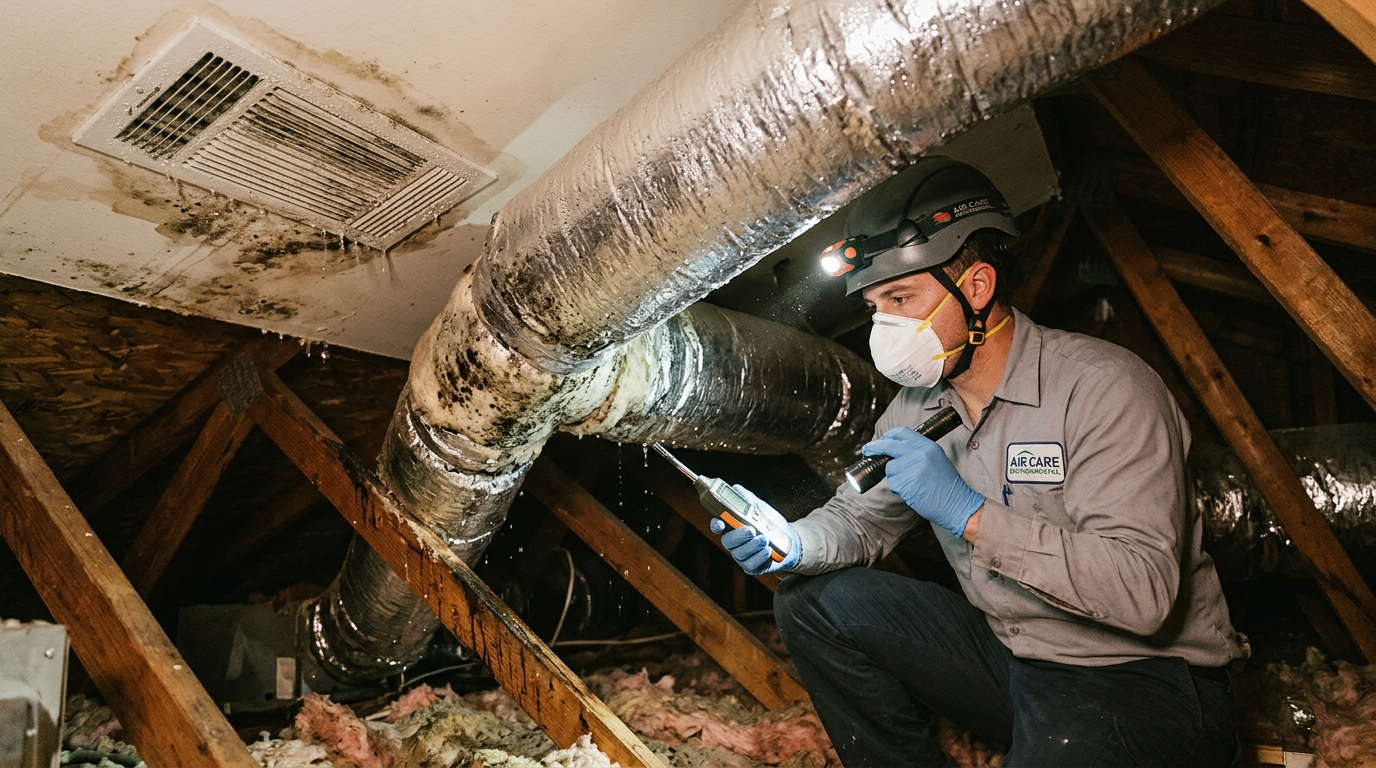
Sensible vs. Latent Cooling Dynamics & Short-Cycling Physics
Air conditioning systems perform two distinct thermodynamic functions: sensible cooling (lowering dry-bulb air temperature) and latent cooling (condensing airborne water vapor into liquid on cooling coils). An oversized compressor satisfies the sensible heat load rapidly, triggering early thermostat shutdown before the evaporator.
Air conditioning systems perform two distinct thermodynamic functions: sensible cooling (lowering dry-bulb air temperature) and latent cooling (condensing airborne water vapor into liquid on cooling coils).
An oversized compressor satisfies the sensible heat load rapidly, triggering early thermostat shutdown before the evaporator coil achieves sufficient chilled surface time to extract moisture. Consequently, latent humidity accumulates relentlessly with every short cycle.
Over a 24-hour period, indoor relative humidity climbs to tropical levels, increasing equilibrium moisture content across household fabrics, carpets, acoustic ceiling tiles, and drywall assemblies.
AC Sweating, Supply Register Condensation & Ductwork Spore Blooms
When chilled 55°F supply air discharges into an environment saturated at 75% relative humidity (frequently observed across Orlando, Jacksonville, Fort Lauderdale, West Palm Beach, and Tallahassee), immediate surface condensation forms along metallic air supply registers, flex duct connections, and return plenums.
When chilled 55°F supply air discharges into an environment saturated at 75% relative humidity (frequently observed across , , , , and ), immediate surface condensation forms along metallic air supply registers, flex duct connections, and return plenums.
This chronic surface dampness allows airborne fungal spores trapped in residential dust to colonize fiberglass duct board linings and supply grilles.
Fungal colonies (such as Aspergillus versicolor and Penicillium) release allergenic mycotoxins directly into high-velocity supply air streams, distributing microscopic bioaerosols into every room in the residence.
HVAC Airflow Testing & Psychrometric Assessment
Certified HVAC diagnostic technicians and environmental investigators measure system psychrometrics using digital psychrometers, anemometers, and static pressure manometers. Technicians verify total external static pressure (TESP), temperature drop (delta-T across coils, ideally 18°F to 22°F), and evaporator airflow rates (standard target: 350 to.
Certified HVAC diagnostic technicians and environmental investigators measure system psychrometrics using digital psychrometers, anemometers, and static pressure manometers.
Technicians verify total external static pressure (TESP), temperature drop (delta-T across coils, ideally 18°F to 22°F), and evaporator airflow rates (standard target: 350 to 400 CFM per ton of cooling).
Psychrometric analysis reveals whether the system is oversized for the home’s Manual J cooling load calculation or suffering from improperly configured multi-speed blower motors.
Corrective Engineering & Botanical Duct Sanitization
Resolving HVAC short-cycling mold requires a dual approach: fungal eradication and thermodynamic re-engineering. Remediators isolate contaminated air ducts under 5,000 CFM negative pressure vacuums equipped with three-stage HEPA filtration, using pneumatic rotary brushes to strip biofilm from duct walls. Technicians apply EPA-registered.
Resolving HVAC short-cycling mold requires a dual approach: fungal eradication and thermodynamic re-engineering. Remediators isolate contaminated air ducts under 5,000 CFM negative pressure vacuums equipped with three-stage HEPA filtration, using pneumatic rotary brushes to strip biofilm from duct walls.
Technicians apply EPA-registered botanical antimicrobials to eliminate residual spores. HVAC engineers then adjust blower fan speeds to maximize dehumidification, install variable-speed inverter compressors, or integrate dedicated whole-home ventilating dehumidifiers (such as Santa Fe or Ultra-Aire systems) operating independently of cooling cycles.