Neuro-Ophthalmic Mechanisms: Retinal Capillary Hypoperfusion
The human retina has one of the highest metabolic and oxygen consumption rates of any tissue in the human body. Retinal ganglion cells and lateral geniculate nucleus (LGN) neurons rely on a continuous, high-volume microvascular blood supply from the central retinal artery.
The human retina has one of the highest metabolic and oxygen consumption rates of any tissue in the human body. Retinal ganglion cells and lateral geniculate nucleus (LGN) neurons rely on a continuous, high-volume microvascular blood supply from the central retinal artery.
When circulating mycotoxins and cytokines (such as VEGF and TGF-β1) cause microvascular endothelial swelling and endothelin-mediated capillary vasoconstriction, local oxygen tension plummets.
This localized ischemia disables magnocellular visual pathways responsible for detecting fine spatial contrast boundaries, producing sharp drop-offs in Columns C (6 cycles/degree), D (12 cycles/degree), and E (18 cycles/degree).
Clinical Administration & Grading Standards
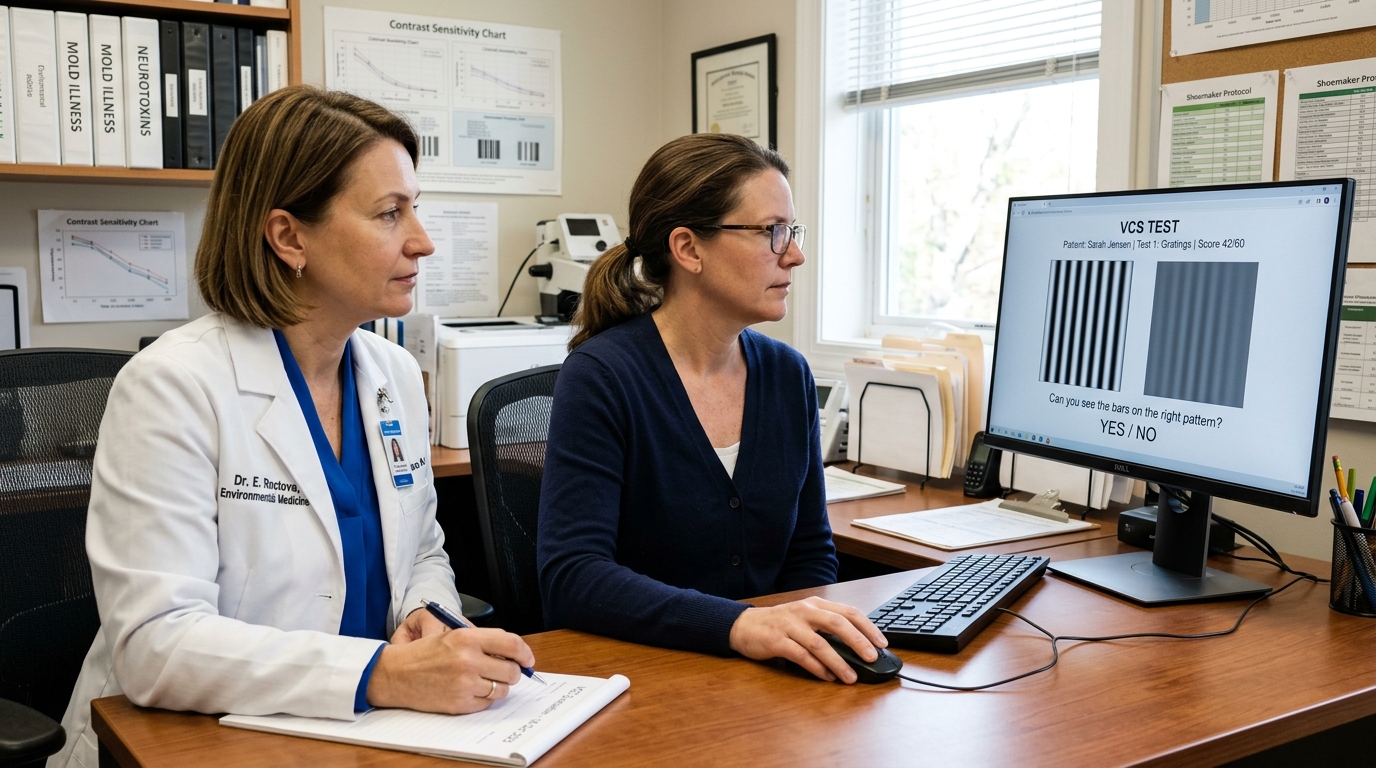
The VCS test presents standardized sinusoidal grating patterns of alternating light and dark bars tilted left, right, or straight up. Patients view the chart under controlled illumination (either in-office calibrated light boxes or standardized online computer screens) at an exact distance of.
The VCS test presents standardized sinusoidal grating patterns of alternating light and dark bars tilted left, right, or straight up.
Patients view the chart under controlled illumination (either in-office calibrated light boxes or standardized online computer screens) at an exact distance of 18 to 24 inches, testing each eye monocularly.
Scoring is calculated across spatial frequencies; failing Column C or Column D in either eye demonstrates statistically significant neurovascular compromise consistent with active biotoxin illness.
Tracking Medical Detoxification & Relapse Monitoring
One of the greatest clinical utilities of the VCS test is its sensitivity as an ongoing recovery monitor. Unlike static genetic tests, VCS scores change dynamically with environmental exposure. As a CIRS patient takes oral mycotoxin binders (such as Cholestyramine) and lives.
One of the greatest clinical utilities of the VCS test is its sensitivity as an ongoing recovery monitor. Unlike static genetic tests, VCS scores change dynamically with environmental exposure.
As a CIRS patient takes oral mycotoxin binders (such as Cholestyramine) and lives in a clean environment, retinal capillary blood flow normalizes, and VCS scores climb back into passing ranges within 2 to 6 weeks.
If the patient re-enters a water-damaged building, VCS scores plunge within 24 to 48 hours, providing an immediate biological early-warning system before severe physical symptoms manifest.
Environmental Verification: Remediating Below the Biotoxin Threshold
A patient with a failing VCS score cannot achieve permanent clinical normalization without complete environmental source remediation: (1) commissioning an independent IICRC certified mold assessment, (2) executing negative-pressure containment (-5 Pa) during deconstruction, (3) physical removal of contaminated drywall, subfloors, and AC.
A patient with a failing VCS score cannot achieve permanent clinical normalization without complete environmental source remediation: (1) commissioning an independent IICRC certified mold assessment, (2) executing negative-pressure containment (-5 Pa) during deconstruction, (3) physical removal of contaminated drywall, subfloors, and AC ductwork,
and (4) small-particle HEPA micro-cleaning to lower indoor fungal DNA counts below strict HERTSMI-2 safety criteria.