The Dual Crisis: Fire Soot Nutrients & Saturated Structural Timber
Attic fire extinguishment creates a unique biological micro-climate where fire suppression water combines with incomplete combustion byproducts (such as carbon black soot, polycyclic aromatic hydrocarbons, and toxic ash residues). Carbonaceous soot particles are highly porous and hygroscopic, absorbing suppression moisture and binding.
Attic fire extinguishment creates a unique biological micro-climate where fire suppression water combines with incomplete combustion byproducts (such as carbon black soot, polycyclic aromatic hydrocarbons, and toxic ash residues).
Carbonaceous soot particles are highly porous and hygroscopic, absorbing suppression moisture and binding it tightly against charred wood framing.
Charred timber surfaces exhibit increased microscopic surface area and open cellular pores, allowing water to penetrate twice as deep into structural members compared to unburned lumber. This creates an abundant, easily digestible nutrient substrate for aggressive secondary fungal colonizers.
Saturated Cellulose & Fiberglass Ceiling Collapse Hazards
Fire suppression water rapidly saturates blown-in cellulose and fiberglass attic insulation, multiplying its dry weight by up to 12 times. A standard 1,000-square-foot attic can hold over 10,000 pounds of water-logged insulation directly above bedroom ceilings. This immense dead load causes structural.
Fire suppression water rapidly saturates blown-in cellulose and fiberglass attic insulation, multiplying its dry weight by up to 12 times. A standard 1,000-square-foot attic can hold over 10,000 pounds of water-logged insulation directly above bedroom ceilings.
This immense dead load causes structural ceiling drywall to sag, buckle, and collapse without warning. In addition, wet insulation creates an anaerobic barrier that traps moisture against ceiling joists, preventing natural convective drying and accelerating fungal hyphae proliferation throughout living space ceiling cavities.
Cryogenic Dry Ice Blasting for Char & Mold Removal
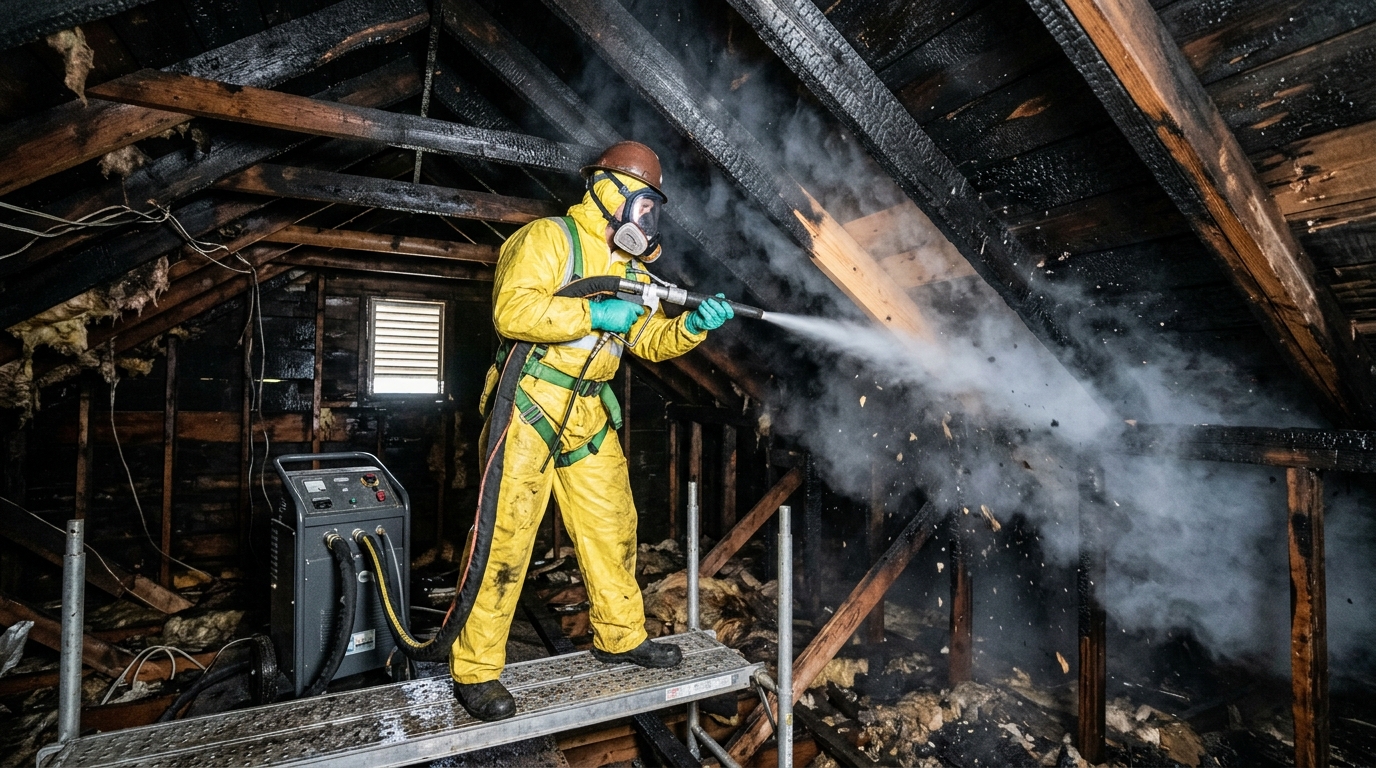
Remediating fire-water damage requires removing both charred wood and fungal contamination simultaneously without causing structural depletion. Certified restoration specialists deploy heavy-duty cryogenic CO2 dry ice blasting units operating at 300 PSI and -109.3°F. Kinetic impact and thermal shock sublimates dry ice pellets.
Remediating fire-water damage requires removing both charred wood and fungal contamination simultaneously without causing structural depletion. Certified restoration specialists deploy heavy-duty cryogenic CO2 dry ice blasting units operating at 300 PSI and -109.3°F.
Kinetic impact and thermal shock sublimates dry ice pellets on contact, stripping away charred wood layers, soot residues, and embedded fungal root structures down to healthy, clean structural timber.
This process eliminates smoke odor sources and fungal contamination in a single non-toxic step without generating secondary water waste.
Odor Neutralization & Structural Drying Verification
Following dry ice blasting and full extraction of wet insulation, technicians erect negative air containment barriers (-5 Pa) utilizing commercial air scrubbers equipped with three-stage filtration (pre-filter, True HEPA, and deep-bed activated carbon/potassium permanganate cells) to capture volatile soot gases and aerosolized mycotoxins.
Following dry ice blasting and full extraction of wet insulation, technicians erect negative air containment barriers (-5 Pa) utilizing commercial air scrubbers equipped with three-stage filtration (pre-filter, True HEPA, and deep-bed activated carbon/potassium permanganate cells) to capture volatile soot gases and aerosolized mycotoxins.
Technicians apply hydroxyl generators or commercial desiccant dehumidifiers to dry structural framing lumber down to verified equilibrium standards below 12.0% WME before applying clear antimicrobial encapsulant coatings.