The Stack Effect Physics Behind Attic Thermal Bypasses
The Stack Effect acts as an unceasing thermal engine in multi-story residential structures during winter months. As heated indoor air rises due to buoyancy dynamics, it generates continuous positive atmospheric pressure against top-floor ceilings and attic boundaries. Any structural void (such as.
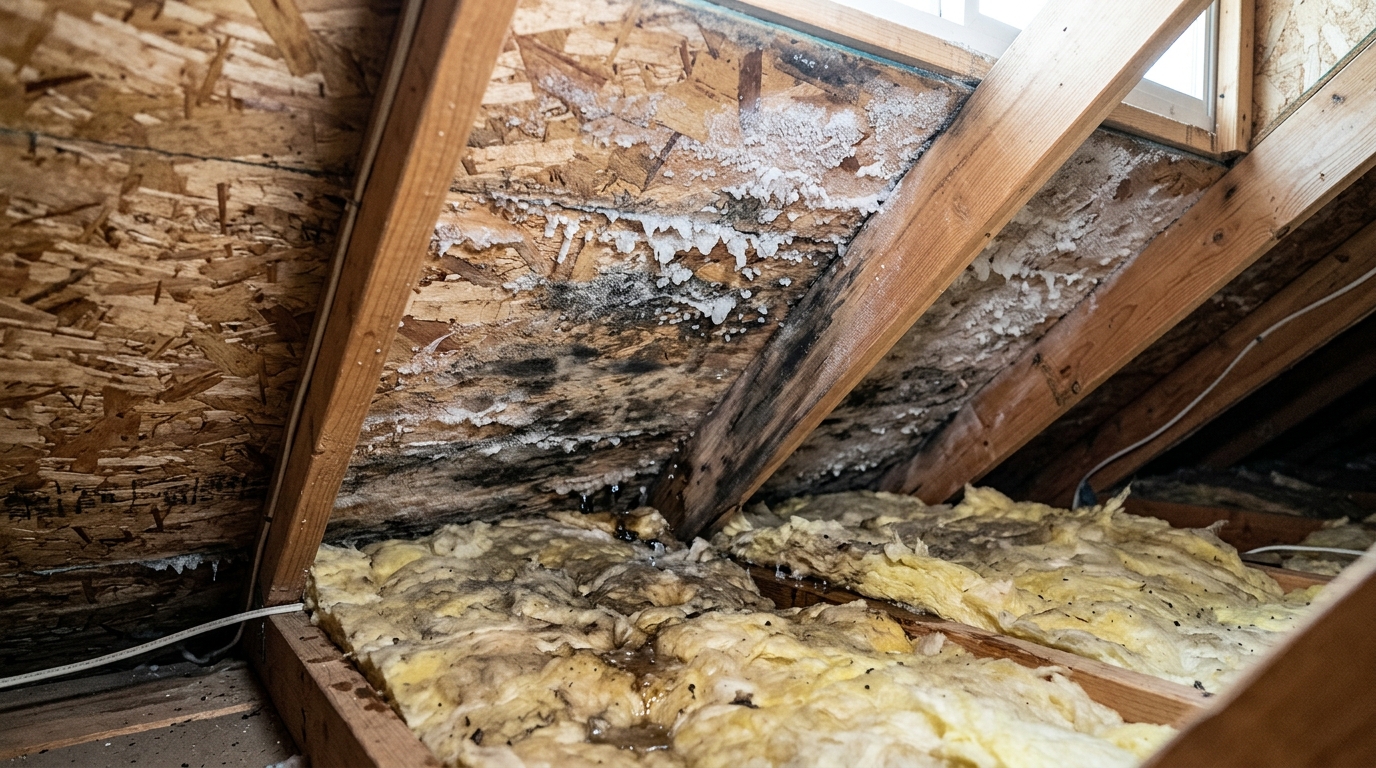
The Stack Effect acts as an unceasing thermal engine in multi-story residential structures during winter months. As heated indoor air rises due to buoyancy dynamics, it generates continuous positive atmospheric pressure against top-floor ceilings and attic boundaries.
Any structural void (such as electrical junction cutouts, HVAC supply boots, uninsulated chimney chases, and open partition wall top plates) functions as a high-velocity convective chimney.
A standard 1/4-inch unsealed gap around a recessed light fixture can transport over 30 quarts of water vapor into the attic envelope over a single winter heating season.
Because cold winter air in the attic holds negligible vapor, this transported moisture deposits directly as solid ice layers onto the north-facing roof deck framing.
The Spring Melt Catastrophe & Condition 3 Ecology
When ambient outdoor temperatures climb above 40°F during spring transitions, frozen roof decks melt rapidly from solar gain. Liquid water drips downward into fibrous ceiling insulation (such as loose-fill fiberglass batts, rockwool blankets, and borate-treated cellulose), creating hidden moisture reservoirs that remain.
When ambient outdoor temperatures climb above 40°F during spring transitions, frozen roof decks melt rapidly from solar gain.
Liquid water drips downward into fibrous ceiling insulation (such as loose-fill fiberglass batts, rockwool blankets, and borate-treated cellulose), creating hidden moisture reservoirs that remain saturated for weeks.
Because attic ventilation (such as soffit intake baffles and ridge exhaust vents) is frequently blocked by compressed insulation, natural convective drying stalls completely.
Fungal colonization transforms pristine structural sheathing into IICRC Condition 3 Actual Contamination characterized by widespread black staining, musty MVOC gas emissions, and structural delamination of OSB adhesive resins.
Cryogenic Dry Ice Blasting Remediation Protocol
Manual scraping and biocidal painting fail on frost-melted roof decking because fungal root structures (hyphae) penetrate up to 3/16 inch deep into open wood grain. Certified restoration technicians deploy cryogenic dry ice blasting units operating at 300 PSI and utilizing solid CO2.
Manual scraping and biocidal painting fail on frost-melted roof decking because fungal root structures (hyphae) penetrate up to 3/16 inch deep into open wood grain.
Certified restoration technicians deploy cryogenic dry ice blasting units operating at 300 PSI and utilizing solid CO2 micro-pellets at -109.3°F.
Upon kinetic impact, the dry ice pellets instantly sublimate into gas, expanding 800 times in volume to shear fungal mycelia and embedded mycotoxins off roof rafters and deck sheathing without abrading the structural wood matrix.
Technicians execute this process inside negative air containment maintained at -5 Pascals using commercial air scrubbers exhausting outside the attic envelope.
Complete Thermal Sealing & Moisture Equilibrium Standards
Remediation is incomplete without eliminating the root-cause thermal bypasses that created the winter frost accumulation. After cryogenic fungal removal and antimicrobial botanical fogging, technicians seal all ceiling penetrations with two-component closed-cell polyurethane spray foam rated at R-7 per inch. Remediators install continuous.
Remediation is incomplete without eliminating the root-cause thermal bypasses that created the winter frost accumulation. After cryogenic fungal removal and antimicrobial botanical fogging, technicians seal all ceiling penetrations with two-component closed-cell polyurethane spray foam rated at R-7 per inch.
Remediators install continuous baffled ventilation channels from soffit to ridge to ensure a minimum 1:150 net free ventilating area (NFVA) ratio. Structural drying fans operate until timber equilibrium moisture content stabilizes permanently below 14.0% WME.